Amaravati Emerges As Nation’s First Quantum Technology Hub

Naidu inaugurates country’s first open-access quantum reference facilities on World Quantum Day
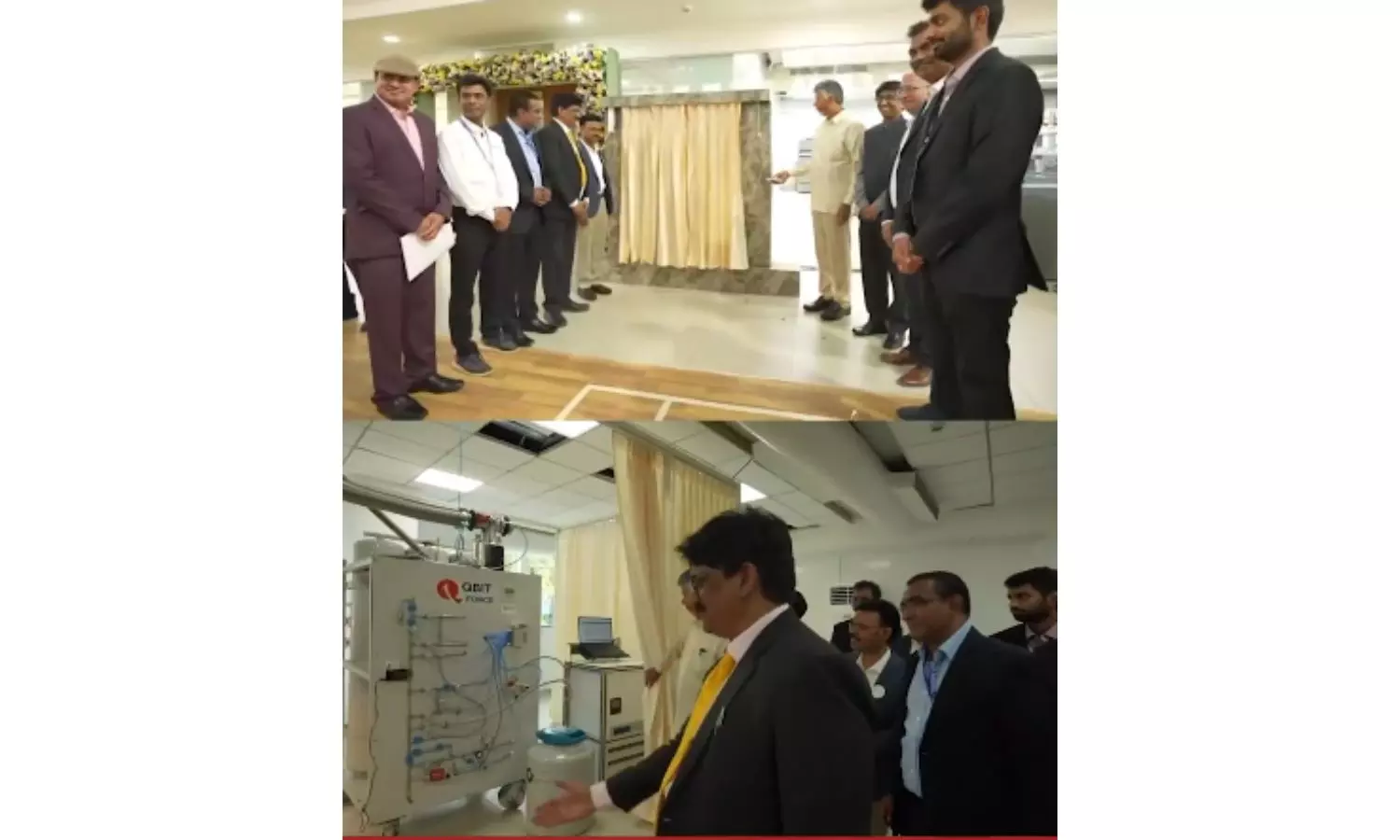
VIJAYAWADA: Marking World Quantum Day, Andhra Pradesh stepped decisively into the frontier of next-generation technology, with Chief Minister N. Chandrababu Naidu inaugurating the nation’s first open-access quantum reference facility centre on Tuesday.
This positions Andhra Pradesh at the forefront of next-generation computing and advanced research.
The twin facilities — one at SRM University and another at Medha Towers in Gannavaram — were launched on World Quantum Day, marking what Naidu described as the beginning of a “new quantum era” in India. These facilities, he noted, function as advanced quantum hardware testbeds designed to enable validation, benchmarking and certification of quantum systems under real-world conditions.
The CM highlighted the far-reaching applications of quantum technology, noting that it could accelerate drug discovery, enhance optimisation in agriculture and industry, and generate employment opportunities for scientists, engineers, cryogenic specialists, software developers and researchers.
Describing the occasion as historic, also coinciding with the birth anniversary of B.R. Ambedkar, Naidu said the establishment of two quantum reference facilities demonstrated India’s growing capability to design, build and deploy cutting-edge quantum systems.
He asserted that Andhra Pradesh is committed to developing an indigenous quantum computer from Amaravati in the near future and called upon scientists, institutions and industry partners to collaborate in realising this goal.
The CM emphasised there’s no dearth of funds for innovation and urged public universities to rise to the challenge by competing with private institutions in promoting research, innovation and startup ecosystems. He stressed the need to build a comprehensive ecosystem by bridging existing gaps in infrastructure, talent and institutional capacity.
Highlighting the significance of the facilities, Naidu said Amaravati Quantum 1S at SRM University and Amaravati Quantum 1Q at Medha Towers “are not merely computing systems but fully functional hardware test beds.”
These facilities, he said, will enable validation, benchmarking and certification of quantum technologies under real operating conditions, offering India a reliable platform to not only study but also build, test and refine quantum systems with confidence.
“With these facilities, AP becomes the first state to commission quantum systems on its soil,” he said, adding that quantum technology would define the future of computing. While one centre strengthens academic and research access, the other is designed to support industry-oriented testing and deployment.
Naidu pointed out that India had missed several global breakthroughs in hardware and product innovation in the past, but “quantum technology now presents a once-in-a-generation opportunity to make up for lost ground.”
He said the state is proud to contribute to the national quantum mission and called for spreading confidence that India can build world-class institutions, infrastructure and talent for the future.
The CM revealed that the project was completed in just eight months through coordinated efforts of leading scientific institutions and industry partners. Contributions came from Tata Institute of Fundamental Research, which provided superconducting qubit processors and amplifiers; Indian Institute of Science, which supported device design and characterisation; and Defence Research and Development Organisation units, which developed quantum control electronics.
Several private firms also played key roles in building critical components such as cryogenic systems, precision instruments and interconnects.
“Notably, the quantum system has been assembled largely using a domestic supply chain, marking a milestone in India’s scientific self-reliance and technological capability,” Naidu said.
Reiterating that “technology should empower every citizen,” Naidu said innovation must not remain confined to a few institutions but should spread across society. He advocated the “one family, one entrepreneur” vision to transform entrepreneurship into a mass movement.
