Beyond Unicorns: Narasimhan Raghavan on Building Businesses That Last

Entrepreneur and author Narasimhan Raghavan makes a compelling case for why India’s future lies not in unicorn hype, but in resilient, grounded businesses built to last
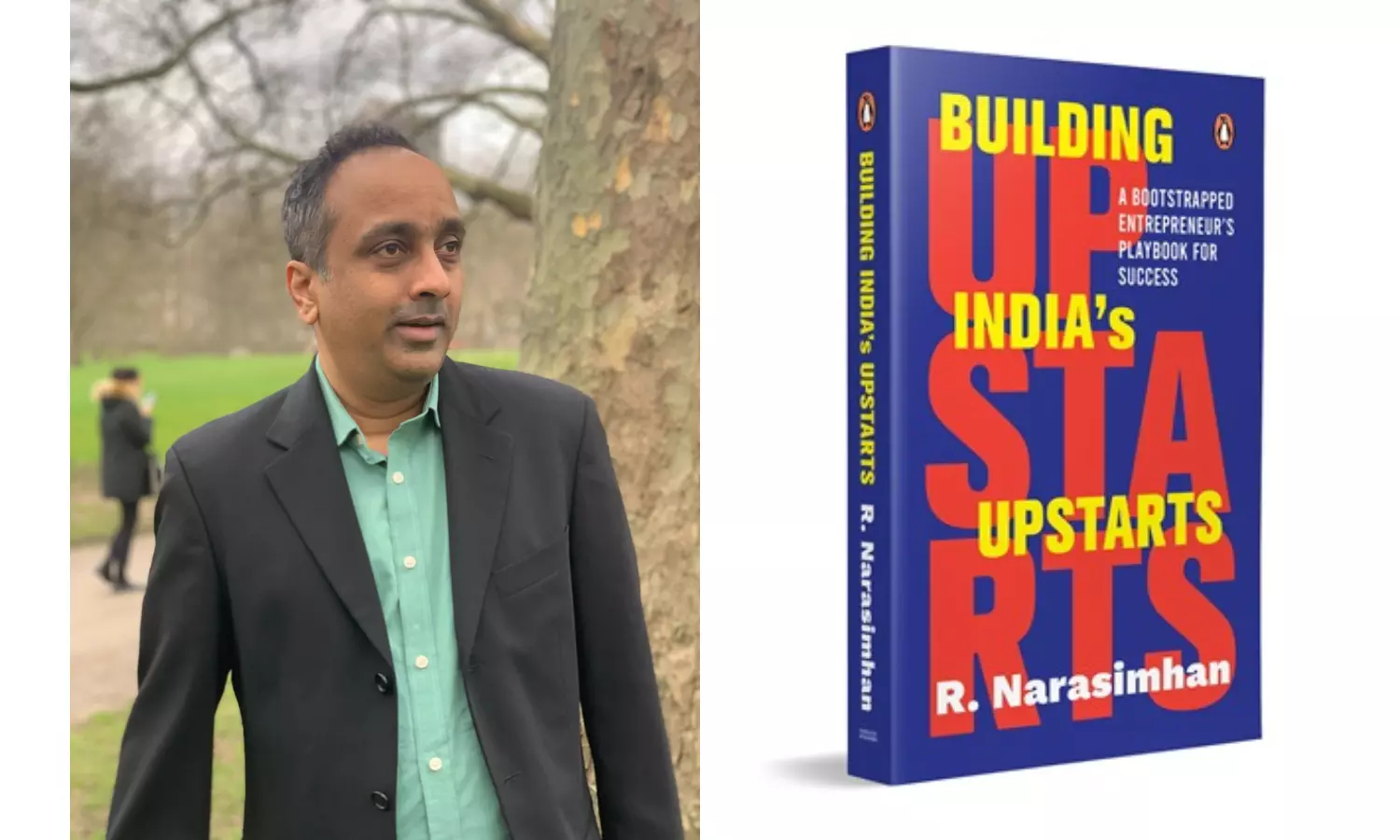
For years, India’s startup narrative has been dominated by a single, glittering milestone: the unicorn. Billion-dollar valuations, rapid scaling, and venture capital funding became the shorthand for success. But entrepreneur and author Narasimhan Raghavan is asking a quieter, more fundamental question--what if that isn’t the only way to build a meaningful business?
“The notion of startups and building unicorns is a fairly recent phenomenon,” he says, almost matter-of-factly. To make his point, he turns not to startups, but to legacy brands. “If you see most of the companies that we interact with today… take examples like Marico or Haldiram’s… none of them really started out by raising billions of dollars or becoming unicorns. They built over decades through disciplined execution.”
That idea of discipline sits at the heart of his book, “Building India’s Upstarts: A Bootstrapped Entrepreneur’s Playbook for Success” published by Penguin. It’s a counterpoint to the dominant narrative, one that argues for steady growth, operational clarity, and long-term thinking over speed and spectacle.
Narasimhan is careful not to dismiss venture capital outright. “Raising capital works for a certain type of business,” he explains. “If you can scale very rapidly and you want to go global quickly, then that model makes sense.” But, he adds, that’s only one slice of the entrepreneurial landscape. “For most companies… it is important to have an alternate model.”
That alternative, in his view, is not just about bootstrapping, it’s about fundamentals. “Ultimately, you need customers. You need a model that works. The product needs to be there because somebody is willing to buy it. Unit economics needs to work, and you need to make a profit.” Capital, he insists, is only one ingredient. “Whether it comes from venture capitalists, or friends and family, or your own savings… that is secondary.”
The recent funding winter, he believes, has only reinforced this thinking. “It was definitely necessary,” he says. Easy money, low interest rates, and global liquidity had created an environment where capital was abundant and often indiscriminate. “When capital stopped coming in… the real cost of money became important. Investors started asking, is my investment really paying off?”
The correction, he suggests, was overdue. “There was definitely some sort of exuberance in the market,” he admits. “I don’t know if a venture capitalist should be funding a coffee house or a tea shop.” His critique is sharp but grounded--certain business models, he argues, were never meant to be venture-backed in the first place.
At the same time, he acknowledges the role of venture capital in driving innovation. “There are great companies that have risen out of good capital. But when money became very cheap… the quality of companies that were funded, and the kind of sectors that were funded, that changed.”
What replaces that excess, according to Narasimhan, is a return to basics, particularly in a market as complex as India. “India is a very diverse country. Geographically, culturally… everything varies.” Success, therefore, often begins with focus. “There are companies that dominate a particular geography, build competency there, understand the market, and then expand.”
He points to businesses that first establish themselves locally before scaling outward. “You understand how to sell your product in one market, you build your economics properly and then you expand.” It’s a model that prioritises depth over breadth, at least in the early stages.
Looking ahead, he sees a shift in where opportunity lies. “There are going to be 1.2 billion people entering the workforce globally in the next ten years,” he notes, referencing a statistic shared by World Bank President Ajay Banga. “And only 400 million jobs are expected to be created.”
For India, this gap presents both a challenge and an opportunity. The sectors that will matter most, he believes, are not necessarily the most glamorous. “Tourism, healthcare, manufacturing, agriculture, food… these are the sectors where jobs will be created.”
In that context, disruption doesn’t always have to mean invention. “You can create something better than what exists today. And over time, keep improving.” Not every business needs to aim for billion-dollar valuations. “You can build a ₹50 crore company with four restaurants. You can have a small network of healthcare centres. These are all viable businesses.”
If there is one trait he values above all, it is resilience. “Let’s assume you don’t have financial discipline in the beginning, you will learn. If you are resilient enough, you will figure out what is working and what is not.”
Failure, in his view, is not an endpoint but a process. “When things fail, you have got to have the stomach to start again. And to keep moving.”
In a startup ecosystem often driven by speed and scale, Narasimhan’s perspective feels like a deliberate pause. Not a rejection of ambition, but a recalibration of what success can look like and how it can be built to last.
Watch the full interview here
