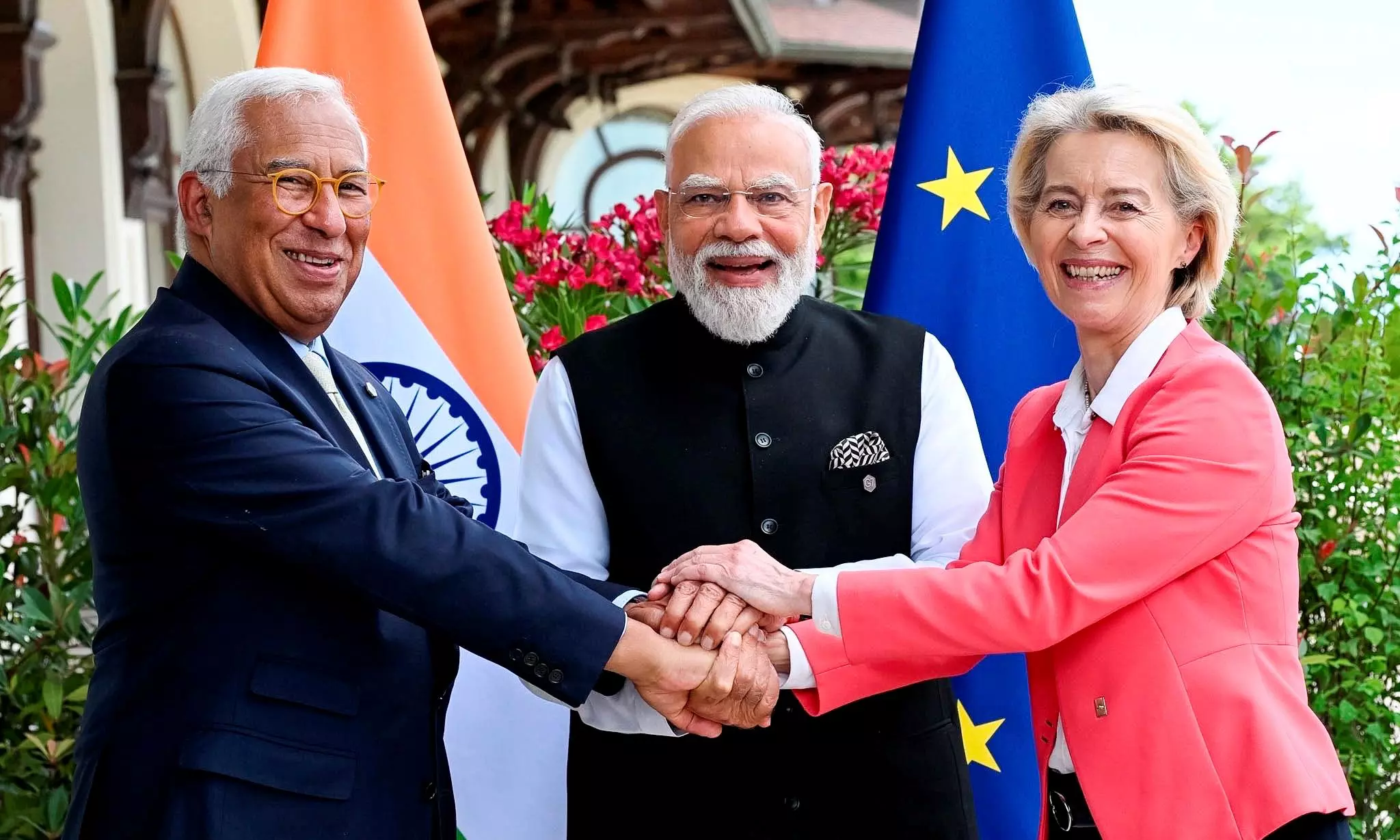
India, EU to Seal Free Trade Deal by 2026 End: Von der Leyen; UK FTA effective on July 15

The EU estimated that the deal will cut up to four billion euros in annual tariffs for European exporters.
Confirming the development, British High Commissioner to India Lindy Cameron said that the India-UK (United Kingdom) free trade agreement (FTA) would come into effect on July 15, 2026. Last week, sources, however, indicated that India and the United Kingdom (UK) had already ironed out one pending issue on implementation of their bilateral FTA, while both sides had exchanged their views as part of resolving two more pending issues.
On the sidelines of the ongoing G-7 Summit in France's Evian, PM Modi on Tuesday had held bilateral interactions with several world leaders, including UK PM Starmer. "Both PM Starmer and I, who are in Evian for the G7 Summit, are naturally very happy with the significant momentum being added to our economic ties. This comes after both sides indicated ironing out of pending issues," Modi said.
The Prime Minister further said that this FTA would also unlock numerous opportunities for Indian farmers, workers, MSMEs, startups and innovators and contribute meaningfully to the realisation of Viksit Bharat 2047.
The sources also said that as the India-UK joint economic and trade committee (JETCO) meeting also due, India's commerce and industry minister Piyush Goyal will go to London for an official visit when the pending issues get ironed out. It, however, indicated that there would be a solution soon to carbon tax and the impending 50 per cent tariffs across 88 tariff lines of steel as among the pending issues.
The JETCO was established on January 13, 2005 to develop a strategic economic partnership and is headed by trade ministers of India and the UK. It was conceived as a business-driven institutional framework to enhance bilateral trade and investment through business to business relationships. The 15th JETCO meeting was held in New Delhi on 13 January 2022, where India and the UK had formally launched the negotiations for their FTA.
UK's Secretary of State for Business and Trade Peter Kyle and UK's Minister of State for Trade Policy Chris Bryant had visited India on June 2 for high-level talks aimed at advancing trade ties and accelerating the implementation of the FTA.
On 15th May, India's commerce secretary Rajesh Agrawal had said that while the FTA with the UK is very close to being operationalised, both the sides are working to resolve the pending sticking points. "The "UK's new steel measure wasn't factored in by the negotiating team," and work is underway to resolve that," he noted.
The UK had decided to cut tariff-free steel import quotas by 60 per cent from July 1, 2026, what many experts described as following the EU’s steel model by combining safeguard restrictions with carbon-linked border taxes.
Hailing the agreement as a triumph of economic statecraft, commerce & industry minister Piyush Goyal said the simultaneous enforcement of the Comprehensive Economic and Trade Agreement (CETA) and the Double Contribution Convention on 15th July 2026 will open up significant new opportunities for India’s exports. " By securing immediate duty-free access on 99 per cent of our tariff lines, we have systematically dismantled long-standing tariff walls. This will effectively level the playing field, allowing our textiles, leather, marine, engineering, and processed food sectors to compete with no disadvantage and supply their world class products," Goyal said.
The minister further said that crucially, this structure is built on absolute economic security; stringent exclusion lists are actively deployed to insulate our sensitive agricultural and rural economies from import volatility. "Simultaneously, by exempting our professionals from double insurance contributions, we are protecting the financial interests of our talent pool. This dual breakthrough aggressively expands our global commercial footprint while fiercely guarding domestic sensitivities," he added.
