Super El Nino Sets Pacific Churning, Indian Monsoon Under Cloud

One of the strongest El Nino’s was in 1997, when the surface temperature in the Pacific Ocean rose by more than 2ºC Celsius.
HYDERABAD: A ‘Super’ El Nino is on the cards this year that could disrupt the crucial life-giving southwest monsoon over India and also result in increased heat over much of India. This is the result of the warming of sea surface waters of the Pacific Ocean.
Coinciding with the latest El Nino forecasts from international weather agencies and research institutions, Skymet, a private weather forecaster in India, on Tuesday said the country could see a below normal monsoon, or poorer rains. For now, according to Skymet, the El Nino impact is expected to be felt in the second half of the June-September monsoon season, but the jury is still out on this.
“There are strong indications that the impacts of El Nino could be felt from June onwards. The only question is how individual months will be impacted,” Dr Akshay Deoras, a research scientist at the National Centre for Atmospheric Science & Department of Meteorology, University of Reading, UK, told Deccan Chronicle.
“When the El Nino occurred in 2015, June was wet but then it started getting dry. Will it be like this year, or different will become clearer in another couple of weeks with updated weather models providing more clarity. For now, the threat is real. The chance of El Nino is almost 100 per cent,” Dr Deoras said.
If there was some uncertainty during February, when scientists started talking about this year’s El Nino, that has now been replaced with certainty. All the climate models predict a strong El Nino. Back in 2014 too, El Nino started forming but it failed as there was not enough ‘response’ in the atmosphere. But despite that being the case, India received less than normal rain that year.
“This year,” Dr Deoras said, “the atmosphere is ‘talking’ through the Madden-Julian Oscillation (MJO) with the Pacific Ocean. This connection is going to become stronger by the end of this month.” The MJO is a major eastward moving tropical atmospheric disturbance, that influences El Nino by triggering westerly ocean wind bursts, that can result in strengthening warm water conditions in the Pacific.
One of the strongest El Nino’s was in 1997, when the surface temperature in the Pacific Ocean rose by more than 2ºC Celsius. Earlier, the Oceanic Nino Index (ONI) system was in place that was used to measure sea surface temperatures (SSTs), but this system has been replaced by the new Relative Oceanic Nino Index (RONI) index. As per the new index, in 2015, after El Nino overcame its 2014 ‘failure’, the SST over the Pacific was peaking at 2.4ºC. “Until last year, the temperature measurement system was different and now RONI is the standard,” he said.
“Any SST over 2ºC will result in a strong El Nino. This is the right time for Indian states to start planning for any eventuality, especially for agriculture sector. June and July are the sowing months, and we have the 2015 example when the monsoon started off well in June and then petered off. Will it be like that this year too? We will know with more certainty by the end of this month,” Dr Deoras said.
What is El Nino?
This year, El Nino is expected to peak just after June, making it into a ‘super event’, a rare occurrence.
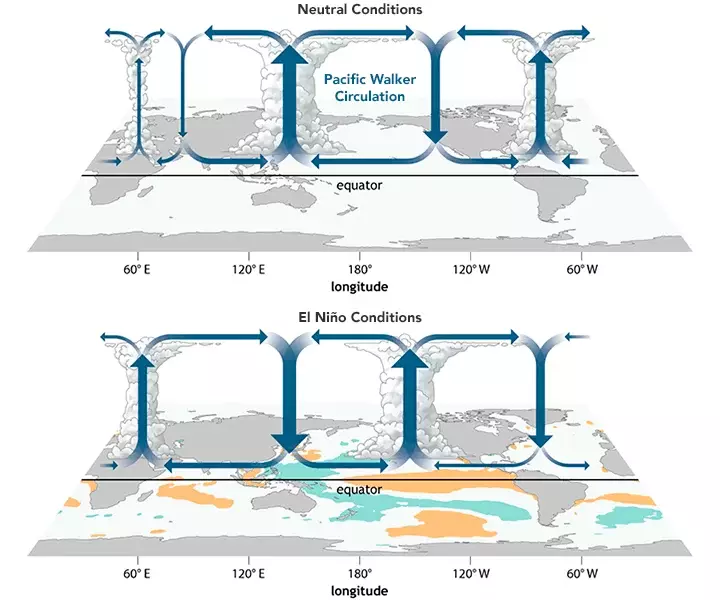
Under El Nino, the Pacific Ocean warms up. This disrupts normal oceanic wind patterns, pushing rain clouds during the monsoon period away from India.
It takes the rain rains to places where this period would otherwise be typically drier.
Models from European Centre for Medium-Range Weather Forecasts, National Oceanic and Atmospheric Administration USA, Bureau of Meteorology Australia point to a strong El Nino this year.
In Spanish, the term means Little Boy, a name given by South American fishermen in the 1600s who noticed periods of unusually warm water in the Pacific Ocean.
Though the full name they gave was El Nino de Navidad, because El Nino typically peaks around December, when Navidad (Christmas) is celebrated.
