Centre Taking More Measures To Attract Foreign Capital Inflows: FM

The RBI on June 5 had allowed banks to access its swap facility for Foreign Currency Non-Resident (Bank) (FCNR(B), deposits with maturities ranging from 3-5 years till September 30. The facility would allow banks to swap US dollar deposits with the RBI, and manage currency risks
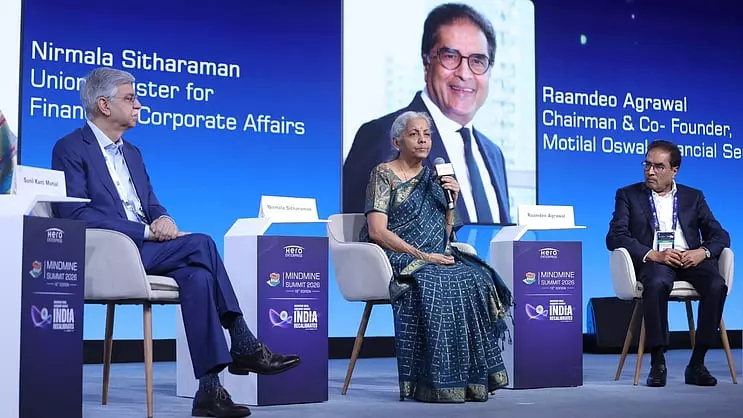
New Delhi: Union finance minister Nirmala Sitharaman on Monday said the measures announced by the RBI and government to boost foreign fund inflows are the 'first step' to bring back foreign capital and indicated that more steps could be in the offing. The finance minister also said that there is a need to be prepared for exigencies arising out of the evolving global situation as the Indian economy is facing 'severe strain' from import of key raw materials, as well crude oil and fertilisers.
“An analysis by the Reserve Bank of India (RBI) and the government has shown that the bond market can be a very good magnet to absorb foreign capital. Accordingly, to reduce compliance burden for foreign investors in government securities (G-Secs), the government on June 5 expanded the list of specified securities under the fully accessible route (FAR) to also include new issuances in G-Secs,” she said while speaking at the Mindmine Summit 2026.
Besides, she said, income tax exemption was given to income from interest and capital gains made by FPIs from investments in G-Secs. “These measures are the first step towards drawing foreign capital back. Although at the moment it's confined to the bond market, certainly that's not the end of the story. There will be more. We recognise, we need more foreign capital to come in,” Sitharaman said.
The RBI on June 5 had allowed banks to access its swap facility for Foreign Currency Non-Resident (Bank) (FCNR(B), deposits with maturities ranging from 3-5 years till September 30. The facility would allow banks to swap US dollar deposits with the RBI, and manage currency risks. Further, to shore up foreign capital inflows, RBI has brought in a forex swap facility to encourage PSUs to raise external commercial borrowings (ECBs) until September 30.
Sitharaman also said that under the framework announced by the RBI, currency hedging would be at the expense of the central bank. “As a result, the banks can now go unfettered, to raise their own funds. So we have taken a very calibrated approach to make sure that the markets do see the required investments,” she said.
