India Inducts Third Nuclear-Powered Missile Submarine

3 April 2026 5:44 PM IST3 April 2026 5:44 PM IST
India is among a select group of countries that possess nuclear-powered submarines. The countries that have such assets are the US, Russia, the UK, France and China
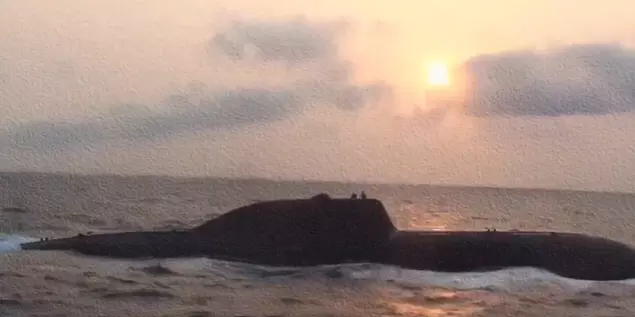
INS Aridaman has been commissioned after months of sea trials. It is learnt that Defence Minister Rajnath Singh attended the commissioning ceremony at a naval base in Kerala. — X.com
New Delhi: India has commissioned its third indigenous nuclear-powered ballistic missile submarine, ‘INS Aridaman’, according to indications from defence minister Rajnath Singh.
Singh posted on X, “Shabd nahin shakti hai, ‘Aridaman’! (It is not a word but power, ‘Aridaman’!)”, signalling the development. There has been no formal official statement on the commissioning.
The 7,000-tonne submarine is nuclear-powered and capable of carrying nuclear-tipped ballistic missiles, strengthening India’s strategic deterrence. It is expected to be equipped with eight K-4 missiles with a range of 3,500 km.
The addition of INS Aridaman to the Strategic Forces Command will enhance India’s nuclear triad — the capability to launch nuclear weapons from land, air and sea. Under its “no first use” policy, India relies on assured retaliatory capability, with sea-based assets providing survivability.
India has previously commissioned INS Arihant, operationalised in 2018, and INS Arighat, commissioned in August two years ago.
Officials have indicated that a fourth submarine under the programme is expected to be commissioned around 2027. Plans are also in place for a new class of larger submarines with higher displacement and longer-range missile capability.
With three such submarines, India is expected to maintain continuous at-sea deterrence by deploying at least one platform underwater at all times.
Separately, India is set to lease a nuclear-powered attack submarine from Russia, to be named Chakra III, for a period of 10 years, with delivery expected around 2027 or 2028 after delays linked to the Russia-Ukraine conflict. Unlike ballistic missile submarines, such attack submarines do not carry nuclear weapons but enhance underwater combat capability.
The developments mark a step in strengthening India’s maritime and strategic defence capabilities.
The 7,000-tonne submarine is nuclear-powered and capable of carrying nuclear-tipped ballistic missiles, strengthening India’s strategic deterrence. It is expected to be equipped with eight K-4 missiles with a range of 3,500 km.
The addition of INS Aridaman to the Strategic Forces Command will enhance India’s nuclear triad — the capability to launch nuclear weapons from land, air and sea. Under its “no first use” policy, India relies on assured retaliatory capability, with sea-based assets providing survivability.
India has previously commissioned INS Arihant, operationalised in 2018, and INS Arighat, commissioned in August two years ago.
Officials have indicated that a fourth submarine under the programme is expected to be commissioned around 2027. Plans are also in place for a new class of larger submarines with higher displacement and longer-range missile capability.
With three such submarines, India is expected to maintain continuous at-sea deterrence by deploying at least one platform underwater at all times.
Separately, India is set to lease a nuclear-powered attack submarine from Russia, to be named Chakra III, for a period of 10 years, with delivery expected around 2027 or 2028 after delays linked to the Russia-Ukraine conflict. Unlike ballistic missile submarines, such attack submarines do not carry nuclear weapons but enhance underwater combat capability.
The developments mark a step in strengthening India’s maritime and strategic defence capabilities.
( Source : Deccan Chronicle )

Next Story