All eyes are on West Bengal, where the fiercely fought election was branded by the Opposition as a battle between the “Indian State and the Trinamul Congress”. In an unprecedented show of force, nearly three lakh personnel from the Central armed police forces (CAPF) were deployed along with an “encounter specialist” from Uttar Pradesh.
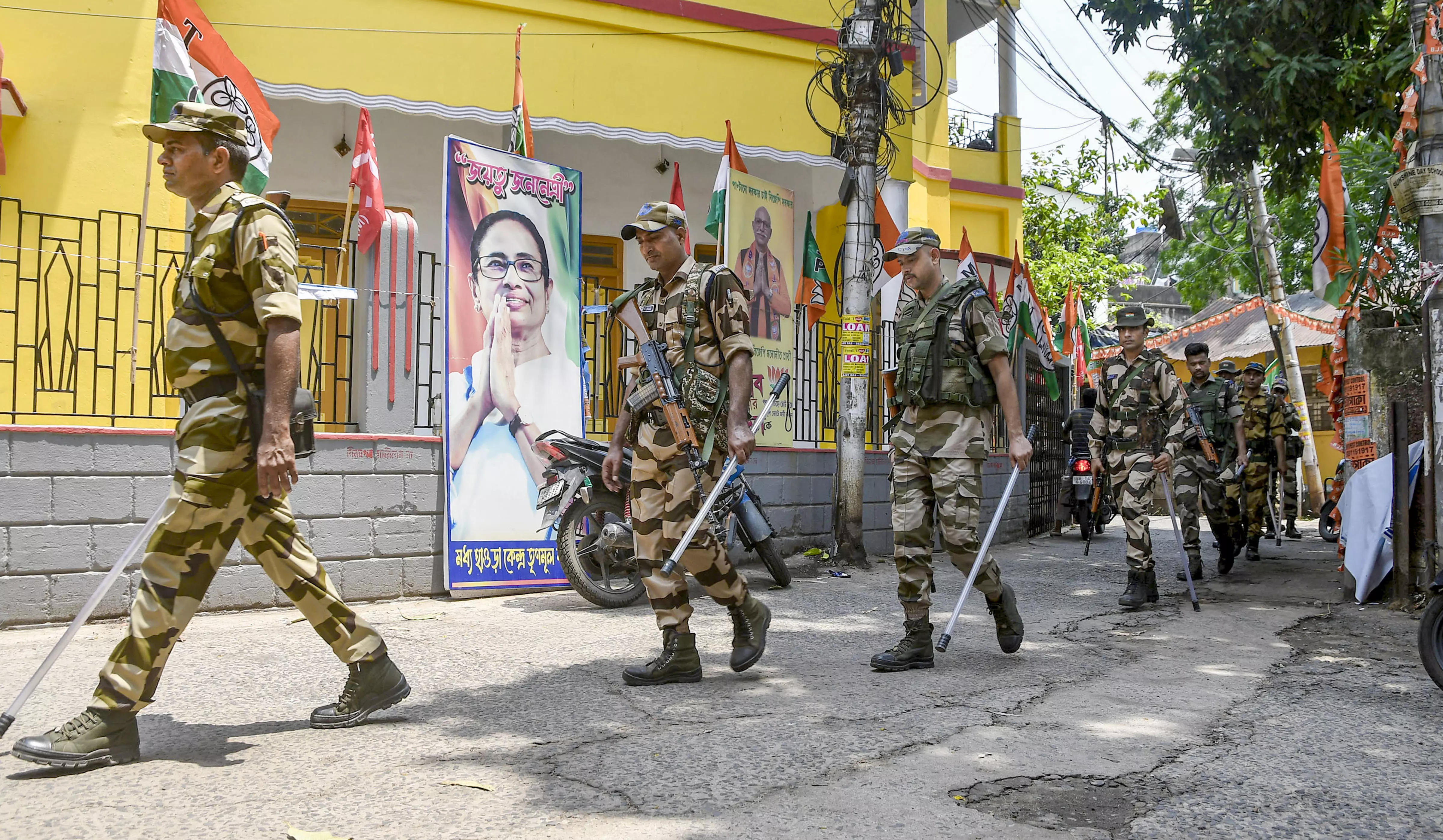
Howrah: Security personnel patrol on the eve of counting and results of the West Bengal Assembly polls, in Howrah, West Bengal, Sunday, May 3, 2026.
With the Assembly election results expected on Monday, palpable tension and nervous anticipation have gripped key poll-bound states, as voters in West Bengal, Assam, Tamil Nadu, Kerala, and Puducherry await the verdict. After a high-decibel campaign, party headquarters, workers, leaders and candidates are on edge, waiting for outcomes that could decisively reshape regional power equations.
All eyes are on West Bengal, where the fiercely fought election was branded by the Opposition as a battle between the “Indian State and the Trinamul Congress”. In an unprecedented show of force, nearly three lakh personnel from the Central armed police forces (CAPF) were deployed along with an “encounter specialist” from Uttar Pradesh. Backed by the full machinery of the Election Commission, the campaign also witnessed a relentless influx of Union ministers and BJP chief ministers, in addition to a massive inflow of cadres from saffron-ruled states.
Not only did Prime Minister Narendra Modi address nearly 14 rallies and multiple roadshows, he also made an effort to woo Bengali voters with carefully choreographed boat ride in the Hooghly, a token kick in a football game and a bite of jhalmuri.
If these were not enough, home minister Amit Shah camped in West Bengal for several days before the final phase of polling on April 29. The Opposition cried foul as the Enforcement Directorate intensified raids across West Bengal during the elections. The ED conducted multiple searches in Kolkata, Siliguri, Burdwan and Habra, primarily targeting TMC-linked functionaries and candidates.
In another first, the EC ordered a repoll in 15 booths following reports of electoral malpractices. To top it all, West Bengal witnessed record high historic voter turnouts since Independence. The overall turnout across two phases was approximately 93 per cent. On April 29, four exit polls (Matrize, P-Marq, Praja Poll and Poll Diary) predicted a big win for the BJP in West Bengal, while two others (People’s Pulse, Janmat) gave a clear edge to chief minister Mamata Banerjee and her TMC. Another exit poll (JVC) predicted a close contest between the TMC and the BJP.
On Saturday, however, the TMC filed a complaint with the Election Commission alleging unauthorised sorting of postal ballot covers at an EVM strongroom in Kolkata. TMC workers camping outside the Khudiram Anushilan Kendra alleged that eight trunks of postal ballots were brought in at 4 am and taken to a room with no CCTV coverage. Late on Saturday evening, in another unprecedented move, the EC announced repolling in all 285 polling stations in the Falta Assembly constituency, reportedly a TMC bastion.
With the exit polls offering mixed signals and close contests predicted in several constituencies, Tamil Nadu awaits a verdict that could either reinforce continuity or mark the beginning of a crucial political realignment. While most surveys indicate that the DMK-led alliance may retain power, though with a smaller margin, the biggest surprise appears to be the emergence of actor-turned-politician Vijay's TVK.
While some polls predicted 10-25 seats for TVK, others indicated 30-40 seats, making it a major player in the state. Axis My India, who refrained from making any predictions for the West Bengal elections, however, placed TVK at nearly 100-120 seats, elevating it to the status of a kingmaker. If predictions for the TVK hold, Tamil Nadu will witness a shift from its bipolar politics to the rise of another regional force.
While the ruling DMK has been given an edge with 120-150 seats, the AIADMK-BJP alliance has been confined to 60-100 seats.
As for Kerala, the state could become the graveyard for the Left, if the Congress-led UDF wins. If the Left Democratic Front (LDF) loses Kerala, the Left parties led by CPM will be out of power all across the country. After losing West Bengal to the Trinamul Congress in 2011, the Left lost Tripura to the BJP in 2018. Kerala is the Marxists’ last bastion. If Kerala falls, the Left risks political irrelevance across the country. Sensing a potential UDF return in Kerala, Rahul Gandhi stepped up his campaign addressing nearly 10 rallies — far more than his six engagements in Tamil Nadu and just three in West Bengal.
In Assam, the BJP led by chief minister Himanta Biswa Sarma is all set to return to power, while the Congress seems to be struggling to keep pace. The Assam campaign saw a bitter, high-stakes battle between the Congress and the BJP replete with personal attacks and charged rhetoric over identity, development and citizenship. In the high-pitched campaign, a section of civil groups and the Opposition also accused Assam CM Sarma of running a “communally charged and divisive campaign”.
If the Congress loses Assam for the third consecutive time, it could sound alarm bells for the party's face in the state, Gaurav Gogoi. There are already murmurs within the organisation, questioning his leadership in the state. In addition, the Congress risks near-total decimation in the state as a third consecutive defeat will demotivate its workers and leaders.
( Source : Deccan Chronicle )


Next Story