NDA asserts no region will face injustice
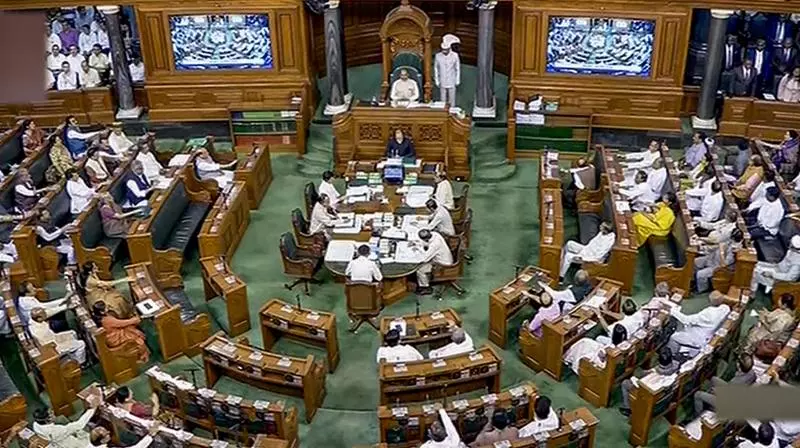
New Delhi: The government and Opposition are headed for a showdown in the Lok Sabha with the tabling of the Women's Reservation Amendments Bill on Thursday. During the three-day special Parliament session amidst ongoing Assembly polls, while the government will move to fast-track other delimitation reforms needed to see through the women’s reservation law, the Opposition will look to corner the Centre over linking it with the delimitation exercise and timing of the debate.
While most political parties broadly extend their support to a 33 per cent reservation for women in the Lok Sabha and Assemblies, many Opposition parties have raised a red flag against linking it with delimitation. On its part, the government is rallying support for The Constitution (One Hundred and Thirty-First Amendment) Bill 2026, calling it a "big-ticket reform". The Opposition has decided to oppose the bill due to its provisions on delimitation.
On the eve of the special three-day sitting of Parliament, Lok Sabha Leader of Opposition Rahul Gandhi said, “The Congress party unequivocally supports women's reservation. Parliament unanimously passed the bill in 2023; it is already part of our Constitution. What the government is proposing now has nothing to do with women’s reservation. This amendment is an attempted power grab using delimitation and gerrymandering."
"We will not allow ‘Hissa Chori’ from OBC, Dalit and Adivasi communities by ignoring the caste census data. We will also not allow Southern, North Eastern, North Western and smaller states to be treated unfairly,” Mr Gandhi said.
Ahead of the tabling of the bill, Prime Minister Narendra Modi said India stands on the brink of making one of the most significant decisions of the 21st century as Parliament meets to end "decades of waiting" by amending the Women's Reservation Act for its implementation in 2029.
Former president Pratibha Patil, ex-Lok Sabha Speaker Meira Kumar and BSP chief Mayawati have welcomed the initiative, but the Opposition claimed that the northern states where the ruling BJP has higher consolidation of its votebank will get more seats in the Lok Sabha while the southern states will get fewer seats due to the population size.
The Opposition parties have also questioned the principle being planned for delimitation, saying, “When the intent behind a bill is mischievous and the content of it is devious, the extent of damage to parliamentary democracy is enormous.”
Ahead of the special sitting, top Opposition leaders on Wednesday met at the residence of Congress president Mallikarjun Kharge to discuss and evolve a joint strategy on the women's quota law. Already two prominent non-BJP chief ministers from the south, M.K. Stalin (Tamil Nadu) and A. Revanthy Reddy (Telangana), have sharpened their attack against the Centre over delimitation, with the Tamil Nadu chief minister warning of "massive agitation" if the state is harmed and his Telangana counterpart flagging "injustice".
The government has countered this by saying there will be no injustice to any state, seats will be increased proportionately, and there will be a 50 per cent increase of current seats for every state. Sources in government said the language of the bill is very clear and straightforward, and any wrong interpretation of this bill should be avoided, adding all issues and doubts will be clarified during the discussion on the bill in Parliament.
"Our democracy will become stronger and more vibrant if the 2029 Lok Sabha elections and various Assembly elections that year are held with women's reservation fully in place," said the Prime Minister.
The NDA sources explained that the final number of the Lok Sabha seats will be determined by the delimitation commission; hence, the bill does not specify an exact seat count or a fixed percentage (such as 50 per cent). The figure of 850 represents only the upper limit for the total number of Lok Sabha seats. The seat allocation will be based on proportional representation, and southern states are likely to benefit under this formula, sources claimed. For this the 2011 Census is being used as the reference point.
According to sources, due to more effective population control in southern states, they could see a relative advantage in seat allocation compared to northern states, where population growth has been higher.
The Constitution (131st Amendment) Bill 2026, also known as the Nari Shakti Vandan Adhiniyam (Women’s Reservation Act), is to ensure the reservation of one-third of the seats of the House for women lawmakers. Accordingly, the amendments, when passed, will ensure an increase in the number of Lok Sabha seats from the present 543 to 850.
A bill on delimitation law and an enabling bill to apply the proposed law in Delhi, Jammu and Kashmir and Puducherry -- three Union territories with legislatures – will also be passed to fast track implementation of the Women's Reservation Act of 2023. The reserved seats will be rotated after every delimitation exercise. The reservation is set for a period of 15 years, which may be extended by Parliament.
The provision of a 33 per cent reservation for women in the Lok Sabha and state Assemblies was brought about by amending the Constitution in 2023. However, under the current law, the reservation for women would not have become enforceable before 2034, as it was tied to the completion of the delimitation exercise post the 2027 census. To implement it from the 2029 Lok Sabha elections, changes are needed in the Nari Shakti Vandan Adhiniyam. Hence, the government is holding the special sitting to pass the amendments to the law.
Amending the Constitution requires a special majority in both Houses of Parliament, which means a majority of the total membership (more than 50 per cent) and a two-thirds majority of members present and voting. The total strength of the NDA in the Lok Sabha stands at 292, while the major Opposition parties have 233 MPs.
Political activist and commentator Yogendra Yadav claimed the bill opens the floodgates for complete reallocation of seats for states and for “gerrymandering”.