Congress Links Women Bill Timing With State Polls

Telangana Chief Minister A Revanth Reddy and other senior leaders attended the meeting in New Delhi
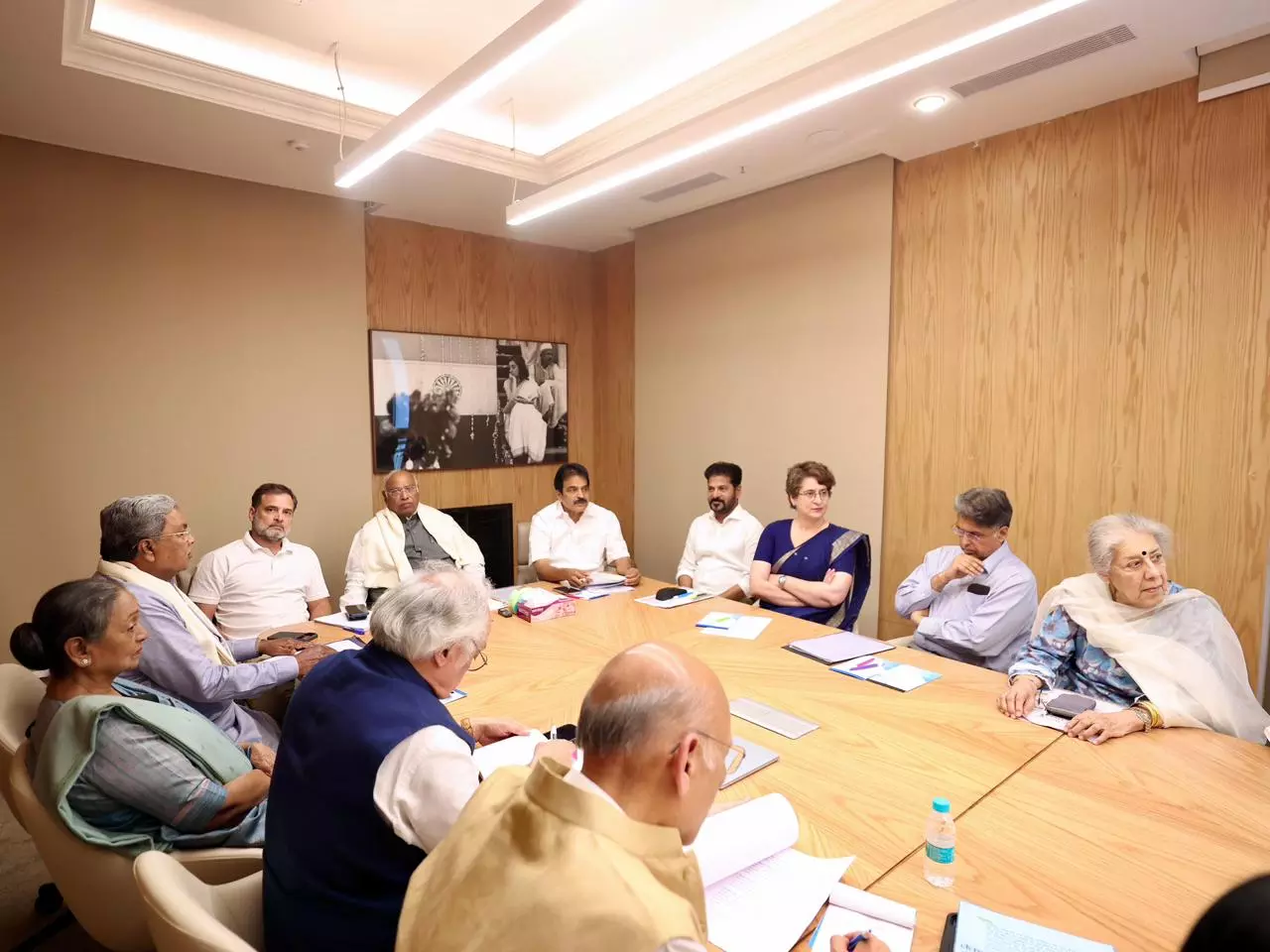
New Delhi: The Congress on Friday launched a sharp attack on the BJP-led government, accusing it of attempting to push through far-reaching electoral and constitutional changes under the cover of women’s reservation while subordinating both democratic norms and national interest to electoral expediency.
Signalling an aggressive political pushback, the Congress announced that it will convene a meeting of the Opposition parties to forge a united strategy ahead of the upcoming Parliament session.
From warning of “grave consequences” of a hurried delimitation exercise to flagging concerns over India’s foreign policy direction amid global tensions, the Opposition party outlined a multi-pronged offensive at the Congress Working Committee (CWC) meeting as key legislative and political battles loom.
Chairing a meeting, Congress president Mallikarjun Kharge accused the government of convening a special Parliament sitting between April 16 and 18 with the “sole intention” of deriving political mileage. He alleged that the proposed constitutional amendment Bill was being pushed in “utmost haste” to enable the BJP to claim credit ahead of ongoing Assembly elections, particularly in politically crucial states.
At the centre of the political storm was the BJP government’s proposed roadmap to implement the women’s reservation law alongside a sweeping delimitation exercise that could alter India’s electoral architecture. Kharge alleged that the move to link women’s reservation with delimitation and expansion of legislative seats was being rushed through without adequate consultation, warning that such steps could have “profound” and “long-term” consequences for the country’s democratic framework.
The Congress fears that the proposed changes, reportedly including a 50 per cent increase in Lok Sabha seats from 543 to 816, with 273 reserved for women, are being advanced without transparency. Kharge pointed out that the Opposition has not received any formal proposal from the government and had instead had to rely on public statements and writings, including those by Prime Minister Narendra Modi, to piece together the plan.
Calling delimitation a matter requiring “very deep deliberation”, Kharge warned that redrawing constituencies alongside expanding seats could fundamentally reshape political representation across states. He reiterated that the Opposition had urged the government to convene an all-party meeting after April 29 once polling in West Bengal concluded to enable a meaningful and informed discussion. The government’s refusal to heed this demand, he alleged, underscores its focus on “narrative-building and electoral gains” over democratic consensus.
Echoing the stance, Congress general secretary Jairam Ramesh said the core issue was not women’s reservation per se, something the party has long supported, but the opaque and potentially disruptive delimitation process tied to it. He confirmed that Kharge would soon convene a meeting of the Opposition leaders, likely ahead of the Parliament session beginning April 16, to chalk out a coordinated response.
Ramesh dismissed the urgency shown by the government, remarking that “heavens are not going to fall” if discussions are held after ongoing elections. He alleged that the timing of the Parliament session is aimed at influencing voters in Tamil Nadu and West Bengal and described the move as an attempt to divert attention from pressing governance issues.
The Congress also raised concerns about the timing of the session itself, noting that many members of Parliament are currently engaged in election campaigning. Kharge termed the move a “violation” of the model code of conduct and went further to question the neutrality of the Election Commission, alleging that it appears to function as a “subordinate office” of the Central government, an assertion that significantly escalates the party’s criticism.
While opposing the government's move on the women’s reservation law, the Congress sought to reclaim its legacy on women’s empowerment, asserting that it has consistently championed reservation for women, from local bodies to Parliament. Mr Kharge recalled that the party had long demanded immediate implementation of the women’s quota and had pushed for a special Parliament session to pass the legislation back in 2023.
"Senior Congress leaders, including Sonia Gandhi and Rahul Gandhi have written numerous letters on this subject… On September 23, 2023, while speaking on the constitutional amendment bill in the House, I demanded that it be implemented immediately," he said.
Gandhi, who attended the CWC meeting along with senior leaders, including Priyanka Gandhi Vadra, reiterated the party’s commitment to “women’s empowerment and social justice”, signalling that while the Congress supports the principle of reservation, it opposes what it sees as its politicised execution.
Beyond domestic politics, the CWC also adopted a strongly worded resolution on the evolving situation in West Asia, welcoming the recent ceasefire as a step towards de-escalation while condemning violations of international law, attacks on civilians, and unilateral military actions. The party invoked global frameworks such as the Geneva Conventions and the United Nations Charter, urging a return to diplomacy and rules-based order.
The CWC resolution said that Modi’s visit to Israel on the eve of war created the perception of a political endorsement of military escalation. "The BJP government’s myopic, xenophobic and unprincipled internationalism has not only alienated India from its neighbours, but also undermined decades of painstaking efforts by successive Indian governments to diplomatically isolate Pakistan," it said.
The resolution also took aim at the BJP government’s foreign policy, warning that recent developments have strained India’s strategic position, undermined energy security, and weakened its standing as a credible voice in the Global South. It accused the government of conflating diplomacy with domestic politics and allowing ideological considerations to override national interest.
Highlighting broader geopolitical concerns, the Congress claimed that India’s diplomatic space has narrowed, enabling adversaries like Pakistan to regain relevance on the global stage. It argued that this shift could have long-term implications for regional stability and India’s own strategic leverage.
Framing the current moment as an “unprecedented polycrisis", the Congress called on the government to take the Opposition into confidence and adopt a unified national approach on both domestic reforms and foreign policy challenges. The party’s message was clear — whether on electoral restructuring or international engagement, unilateralism and haste could come at a steep cost to democratic integrity and national interest.
