Delimitation Will Make Southern States Irrelevant, Says Revanth

Speaking at the Congress Working Committee (CWC) meeting held in New Delhi, Revanth Reddy said such a move could be politically disadvantageous to southern states.
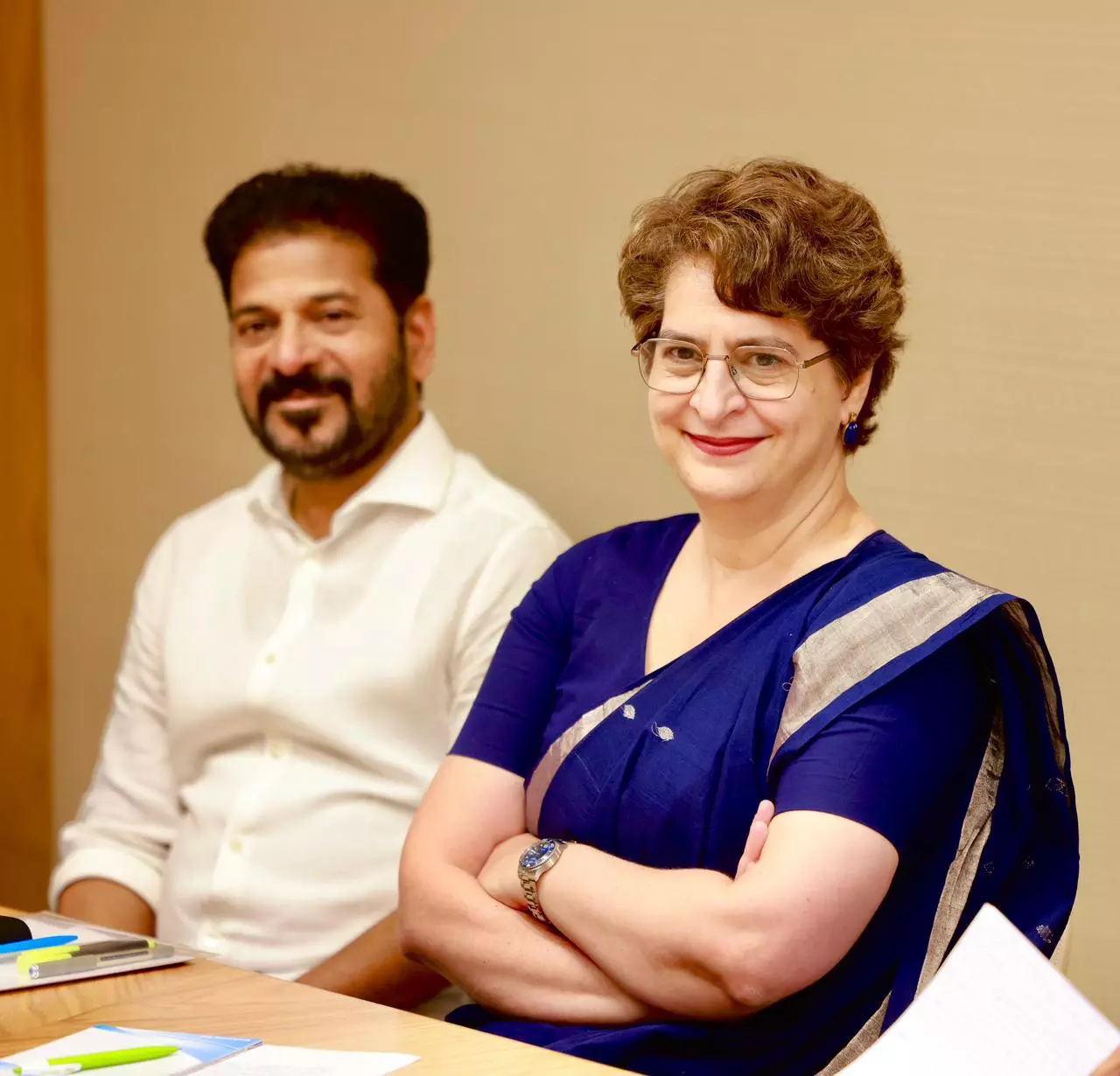
Hyderabad: Chief Minister A. Revanth Reddy on Friday said he had conveyed his serious concern over the BJP-led government at the Centre’s proposal on delimitation of constituencies to increase Lok Sabha seats by 50 per cent uniformly across all states. Speaking at the Congress Working Committee (CWC) meeting held in New Delhi, Revanth Reddy said such a move could be politically disadvantageous to southern states.
In an informal chat with mediapersons after the CWC meeting, Revanth Reddy termed the proposal as “anti-South India” and cautioned that it could allow non-southern states to determine who comes to power at the Centre, leaving southern states with a diminished role.
Revanth Reddy said southern states were already suffering financially due to reduced grants from the Centre and warned that the latest delimitation formula would result in political losses as well. “The delimitation formula is discriminatory. It is in favour of bigger states and against smaller states like Telangana. This may lead to conflict between bigger and smaller states,” he cautioned.
The Chief Minister suggested that the Lok Sabha seats in states should be increased based on the respective state economies and GDP growth rates. He also sought that the delimitation exercise be taken up only after the completion of the Census 2027 exercise in March 2027.
Revanth Reddy opined that a uniform 50 per cent increase in seats across all states appeared to be a “conspiracy” by the BJP to secure power at the Centre without depending on southern states, where it lacks a strong ground presence.
He said the proposal would further deepen the north-south divide, pointing out that northern states such as Uttar Pradesh, Madhya Pradesh, Bihar and Rajasthan, which already have a higher number of Lok Sabha seats, would gain disproportionately more seats compared to southern states. He noted that the strength of the Lok Sabha would increase from 543 to 816, along with a proportional increase in seats in all state legislative assemblies.
Revanth Reddy pointed out that currently, out of 543 Lok Sabha seats, southern states account for only 130 seats, while non-southern states hold 413. With a 50 per cent increase, southern states would have 195 seats out of 816, while non-southern states would command 620 seats. “In this scenario, who will give value to the southern states? With a 50 per cent seat hike, southern states will become politically irrelevant,” he remarked.
Illustrating the disparity, he said seats in Uttar Pradesh would rise from 80 to 120, while the combined strength of Tamil Nadu and Puducherry would increase only from 40 to 60, widening the gap from 40 to 60 seats.
The Chief Minister suggested that if the Centre proceeds with increasing Lok Sabha seats, it should evolve a formula to maintain the existing balance between northern and southern states. He added that even if delimitation is carried out purely based on population, southern states would still be at a disadvantage as they had effectively controlled population growth in line with the Centre’s directions and would now be penalised for successfully implementing family planning measures.
Revanth Reddy appealed to the party high command to wage a united battle in Parliament, along with like-minded parties, against the proposed delimitation model.
The Chief Minister said that if southern states unite and mount a collective resistance against the proposed delimitation, the Modi government would be forced to backtrack, just as it did in the case of controversial farm laws following intense protests from farmers.
He alleged that the Modi government was treating southern states as “second-class states” in the country. He claimed that the Centre had planned a special session of Parliament from April 16 to 18 to pass the 33 per cent women’s reservation bill in a bid to gain political mileage ahead of the elections in Tamil Nadu, scheduled for April 23, and West Bengal, where polling is set to be held on April 23 and 29.
