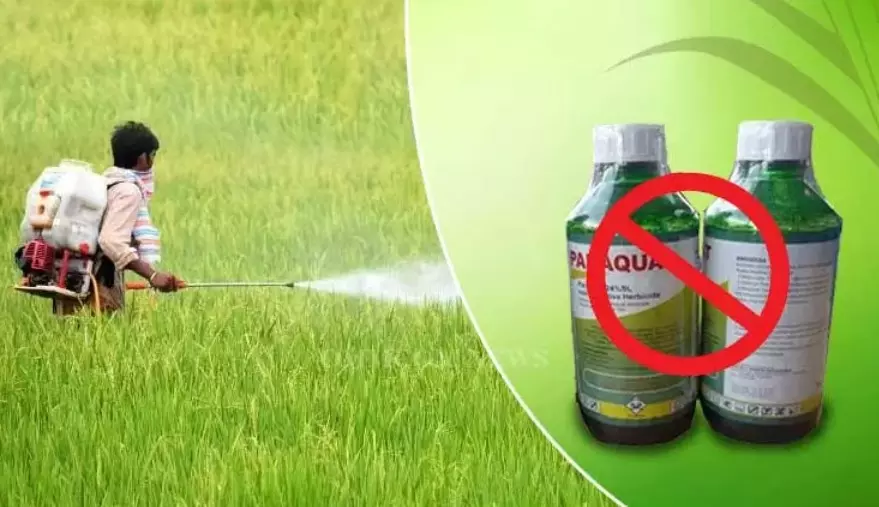
WARANGAL: Despite the Telangana government’s order requiring a prescription for purchase of herbicide paraquat dichloride, lack of enforcement is a serious cause of concern. Easy access to the herbicide for farming community has made it the choice of suicidal or extremely stressed to end their lives.
Hanamkonda District Agriculture Officer (DAO) Ravinder Singh pointed out that fertiliser dealers are strictly required to follow rules and sell paraquat dichloride based only on a formal prescription issued by Mandal Agricultural Officer (MAO) or Agricultural Extension Officer (AEO) after a field inspection. Failure to comply with this condition can lead to immediate cancellation of the fertiliser dealer’s license.
However, it has become common for farmers to reuse old prescriptions for repeat purchases. This is despite shop owners being prohibited from selling the herbicide on previous prescriptions. A new prescription for every purchase is mandatory, the DAO pointed out.
Practical difficulties in enforcing this condition are evident in erstwhile Karimnagar and Warangal districts. A local fertiliser dealer, speaking on condition of anonymity, said they are struggling due to the prescription-based system. While some farmers bring formal prescriptions, a large number of them remain unaware. Many travel from distant villages to reach their shops. Considering this, the product is being sold to them.
The deadly nature of paraquat dichloride has led to a decade-long study by Dr. Manjusha Yadla, Head of the Nephrology Department, Gandhi Hospital. She has analysed 400 cases and found that 73.7 per cent of patients succumbed to the poison despite receiving medical treatment. 90 per cent of these cases are intentional ingestion driven by financial distress and social pressures, with the average age of victims being just 30 years.
In Karimnagar, 24-year-old Katikareddy Sumanth used the herbicide to take his life over the inability to pay a motorcycle EMI. A 45-year-old farmer Mogili Laxman in Achannapalli village of Rajanna Sircilla district consumed paraquat dichloride at his field after falling into a debt trap caused by failed borewells.
More poignant is the account of a 25-year-old female farmer in Karimnagar. After a domestic quarrel, she swallowed the toxin in a moment of heat. Upon reaching the hospital, she pleaded with doctors to save her for the sake of her two small children. However, because paraquat causes irreversible systemic failure, she died.
It is estimated that nearly 2,000 people die across Telangana every year after consuming this herbicide. Recognising its lethal nature, states like Kerala, Odisha and Punjab have banned paraquat dichloride, as it has no known antidote.
Dr. Mahesh Reddy, a physician who has witnessed such tragedies first-hand, has been touring the erstwhile Karimnagar district to educate farmers that there is no medical cure once the herbicide enters the bloodstream.
Significantly, Warangal MP Dr. Kadiyam Kavya has on Friday demanded in the Lok Sabha an immediate national ban on the dangerous paraquat herbicide. Speaking during the Zero Hour, she pointed out how the chemical is damaging the environment and becoming choice of suicides in rural areas. She underlined that because there is no known antidote to the herbicide ingestion, almost 100 per cent of people who consume it end up dying.
At a recent awareness meeting, Indian Medical Association (IMA), Telangana chapter president Dr. P. Kishan termed paraquat dichloride an enabler of death in rural households. As loopholes are continuing to add to the death toll, Dr. Kishan said the IMA is preparing for a national-level “Chalo Delhi” protest, seeking a total and effective ban on the production and sale of all forms of paraquat.
The Telangana State Farmers Commission has reiterated its plea for a total ban on the herbicide, noting that over 70 countries have already prohibited the substance. The issue has reached the highest levels of governance, with the commission submitting a detailed report to Chief Minister A. Revanth Reddy and Agriculture Minister Tummala Nageswara Rao.
The commission has urged the state to move beyond local restrictions and petition the central government for a nationwide ban on paraquat.
Doctors, toxicologists issue chilling warning over paraquat dichloride use
Healthcare professionals and toxicologists have issued a chilling warning over the extreme toxicity of the herbicide paraquat dichloride. With no known medical antidote available globally, the chemical acts rapidly upon ingestion, causing catastrophic failure of the lungs, kidneys and liver.
Beyond intentional ingestion by the suicidal and stressed, medical community has raising alarms over the severe risks posed to agricultural labourers during routine application of the herbicide over crops. The chemical can enter the human body through skin contact or inhalation.
In the absence of high-grade personal protective equipment (PPE), workers suffer from chronic respiratory diseases, skin burns, loss of fingernails and deteriorating eyesight.
Further, international research has established a link between paraquat exposure and a significantly higher risk of Parkinson’s disease, as the toxin attacks the nervous system and impairs motor functions over time.
Healthcare Reforms Doctors Association (HRDA) has expressed grave concern over the rising number of deaths due to the herbicide, classifying the issue as a national policy crisis, rather than a mere medical emergency. Due to its easy availability, it is a poison of choice for the stressed to take their own lives.
HRDA representative Dr. Bandari Rajkumar, a critical care specialist, highlighted that the victims are predominantly youth and farm workers. He pointed out that it is easy to purchase this liquid death through local pesticide shops and unregulated online platforms. Doctors have little choice to save lives once a person has ingested the paraquat.
In light of these findings, the HRDA has formally demanded that both the central and state governments establish a high-level national committee to examine the issue before imposing a complete ban on the herbicide. This proposed body would include toxicologists, medical associations, policy-makers, and farmers' representatives to conduct a comprehensive study on the impact and regulation of herbicides.
HRDA underlines that current measures are insufficient and immediate systemic changes are required to prevent further loss of life within the productive rural population.
Medical experts observe that until the substance is completely removed from the market, it remains a ‘ticking time bomb’ in every rural household, capable of turning a momentary unhappiness into a permanent tragedy.