Ghose Commission’s Barrage of Charges Against KCR, Harish, Etala

P. C. Ghose panel flags irregularities in barrage decisions
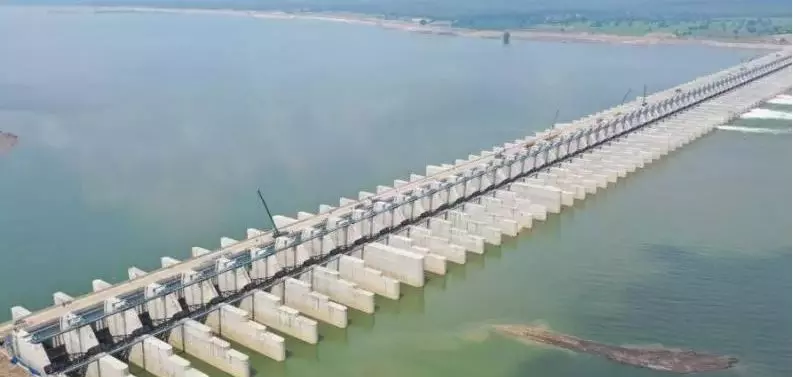
Hyderabad: The voluminous three volume 650 page report of Justice P.C. Ghose commission of inquiry report on Kaleshwaram project barrages, submitted to the government last August, had made it clear that the then Chief Minister K. Chandrashekar Rao leading the BRS government, followed by the then irrigation minister T. Harish Rao, as well as the then finance minister Etala Rajendar, who later left BRS and went on to become a BJP MP, were directly involved in the decision making processes that eventually resulted in the Medigadda barrage of the project suffering serious damages.
The top billing in terms of responsibilities for the series of lapses that resulted in part of the Medigadda barrage developing serious problems was reserved by the Commission for Chandrashekar Rao. The former chief minister, the Commission said in its report, was “directly and vicariously accountable for the irregularities and the illegalities in planning, construction, completion, operation and maintenance of the three barrages.”
Not stopping there, the Commission had also said that his “involvement and directions minutely” was the “cause” and resulted in “irregularities” that caused “distress to these three barrages.” The Commission was referring not just to Medigadda, but also the barrages at Annaram and Sundilla.
The then chief minister was “pre-determined and bent upon to construct a barrage at Medigadda at his free choice and the authorities associated with the decision making” facilitated this, the report had said.
Going further, the Commission also said, “It can be categorically held that there is rank irregularity from the stage of conceptualization of Kaleshwaram project till issuance of administrative approvals on March 1, 2016, for construction of the three barrages. This is not the decision of the government but of individuals,” the report said.
On the role of Harish Rao as the irrigation minister during the period of the project’s conception and execution, the Commission said that he allowed the chief minister to fulfil his desires and is liable for irregularities. Among the faults attributed to Harish Rao were that he, along with the then chief minister, “intentionally not considered the report of the expert committee.” The Commission was referring to a committee set up by the BRS government in January 2015 which in its report said a barrage at Medigadda was unviable and uneconomical, and that instead, a barrage can be planned at Vemanapally on Pranahita river.
Noting that the committee report was submitted to Harish Rao as the irrigation minister, the Commission held that this report was suppressed and “the proposal and the decision to construct barrages at Medigadda, Annaram, and Sundilla is of the then minister of irrigation and chief minister.” And during presentation of his evidence to the Commission, Harish Rao “has not denied” its submission, the Commission had pointed out.
The Commission, referring to administrative sanction for the barrages, said Harish Rao had signed it, as did Chandrashekar Rao, without Cabinet approval, which it held was a violation of the Business Rules of the government.
On Etala Rajendar’s role as the then finance minister, the Commission had held that he was a “tacit perpertrator” and that while Harish Rao gave “instructions at random”, Rajendar “demonstrated lack of commitment and integrity in safeguarding the financial and economic health of the newly formed state” and that during the Commission’s hearings, pleaded ignorance of crucial financial decisions related to the project.
Infograph
Some key findings of the Ghose Commission
No proper planning, wrong estimates, illegal approvals
Contracts awarded illegally
Revised estimates malicious, undue favours to agencies
Barrage designs fundamentally defective
Poor quality control, defective construction
No operation and maintenance, no manuals, no agreements
Illegal completion certificates and bank guarantee releases
Financial mismanagement
