417 Boreholes Needed, but So Many Can Weaken Structure
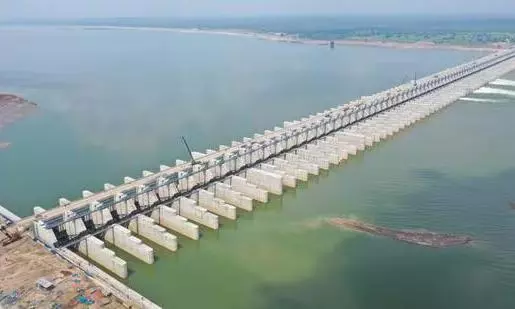
Hyderabad:The prospects of completing preparations for repairs by the end of this year at the three barrages at Annaram, Sundilla, and Medigadda of the Kaleshwaram Lift Irrigation Scheme now appear remote as various tests at the barrages have fallen far behind schedule.
This problem appears to be most severe at Medigadda, where, as per the testing plan, 417 boreholes were to be drilled on the raft — the floor section of the barrage — for a ‘cross-hole seismic test’. This test is meant to check the continuity and integrity of the secant piles on both the upstream and downstream sides of the barrage.
But doing this has turned into an easier-said-than-done situation with the apparent dawning of a serious problem with the plan to drill so many boreholes. While 12 of the 417 planned boreholes have been drilled, this work has now been stopped as those in charge of the work apparently realised that to complete this task, the “raft would have to be punctured, potentially damaging critical structural components.” The boreholes are needed to study the structural integrity of the barrage, but drilling them could well weaken the structure itself, and this conundrum has been passed on to the National Dam Safety Authority for suggestions, it is learnt.
A deadline-based plan of action for conducting various tests at Medigadda, Sundilla and Annaram barrages was finalised this April at a high-level review of repair plans at Medigadda that was led by Chief Minister A. Revanth Reddy.
The various tests were proposed by the Central Water and Power Research Station, Pune, based on suggestions from the NDSA.
Similarly, work on 45 boreholes for assessing seepage path using ‘tracer studies’ at Medigadda has not made any progress, but this task, according to sources, is now scheduled to be completed by June 15.
Meanwhile, geophysical studies for a 3D stress-analysis are yet to be taken up. Also to start is the assessment of the condition of the 85 radial gates of the barrage. Another challenging task, extracting cores from 12 boreholes for strength studies, is yet to begin. Previous attempts showed that sand and soil collapse immediately after core extraction.
While a hydraulic model study that generates tail water data, and a 2D model study that helps with understanding the discharge capacity from each vent of the barrage as per its present design are reportedly under way at CWPRS in Pune, a required 3D model study which can provide data on whether the barrage can carry floodwaters as designed, is expected to be completed only by the end of this November.