Telangana Second In Niti’s School Transition Rankings

This reflects a wider national trend, with government school enrollment falling to 49.24 per cent in 2024‑25 from 71 per cent in 2005, driven largely by parents preferring private schools that promise better English‑medium education.
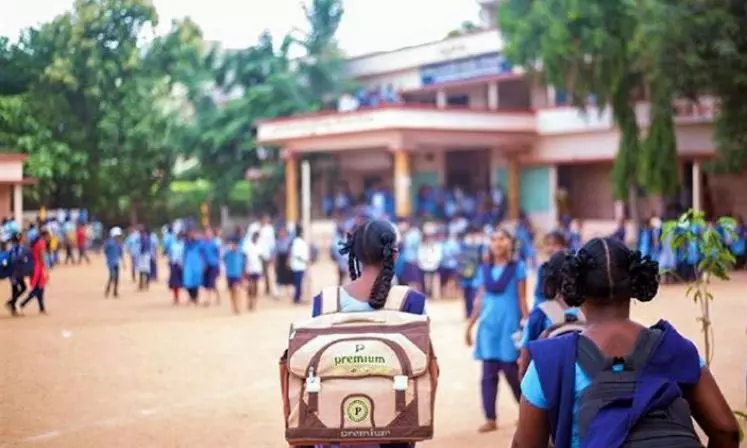
Hyderabad: Telangana has been ranked second, behind only Puducherry and Kerala, in the number of students making the transition from upper primary to secondary education in government schools, according to a Niti Aayog report released on Thursday.
Excluding the Union Territories of Chandigarh and Lakshadweep, Telangana stood second among states with the highest transition rate at 98.9 per cent, behind Puducherry and Kerala at 99.6 per cent.
The state has also made progress in reducing dropouts and strengthening infrastructure. However, a sharp fall in government school enrollment points to continuing challenges. Enrollment in government schools in Telangana has dropped to just 26 per cent for Class 1 students in 2024‑25, down by over 40 per cent since 2013‑14, while private school enrollment has crossed 60 per cent.
This reflects a wider national trend, with government school enrollment falling to 49.24 per cent in 2024‑25 from 71 per cent in 2005, driven largely by parents preferring private schools that promise better English‑medium education.
The dropout rate at the secondary level stood at 13.2 per cent, with government schools performing better than the national average in the enrollment of girls and overall students, possibly aided by the mid‑day meal scheme. Most government schools now have computers, though internet access remains low at 43.3 per cent. The average pupil‑teacher ratio stands at 22:1.
However, the Telangana state United Teachers Federation disputed the report’s findings on the student‑teacher ratio, claiming it was considerably higher at 35:1 on average and in some places up to 50:1. Union president Nukala Narsing Rao attributed falling enrollment at the primary level and student dropouts to migration of parents.
He pointed out that many students enrolling in government schools in districts adjoining Hyderabad are from migratory families of several north Indian states. He also blamed the “fancy” of parents enrolling children in private schools under the mistaken belief that they offer quality English‑medium education.
Narsing Rao further said internet access in government schools has improved considerably in the last year, following the government’s provision of BSNL connections. He claimed Medchal district has achieved 100 per cent internet connectivity.
Noted educationist Dr M. Srinivas said the improvement in transition and dropout rates was encouraging, but stressed that “the declining enrollment in government schools shows that quality perception among parents still needs serious attention.”
The report also noted that public schools continue to face dilapidated infrastructure, teacher shortages, deployment of staff in non‑teaching duties, and excessive emphasis on rote exam preparation instead of conceptual learning, especially in junior colleges. Rote exam prep refers to studying by memorising facts, formulas, or definitions through repetition without necessarily understanding the underlying concepts.
India now has 14.71 lakh schools with more than 24.69 crore students, making it the world’s largest school system. However, the report said that sheer scale has not yet translated into uniformly high‑quality education, particularly in rural and underserved areas.
Among systemic reforms, NITI Aayog has proposed restructuring scattered tiny schools into “composite schools” or school complexes, backed by evidence‑based rationalisation to avoid academic gaps when small units are merged. The aim is to ease the burden on single‑teacher schools, improve infrastructure pooling, and reduce administrative fragmentation across districts.
The report also calls for a governance overhaul, including stronger School Management Committees, professional training for school heads, and the creation of state and District Task Forces on School Quality to ensure coordinated implementation. On the human‑capital front, it recommends a more strategic teacher deployment mechanism, filling chronic vacancies, and improving continuous professional development with a sharper focus on pedagogy and learner outcomes.
The roadmap further envisions AI‑based learning platforms, AI‑assisted lesson planning, and adaptive assessment systems that can track individual learning levels, especially among children already behind in foundational skills. At the same time, it stresses that digital tools must complement, and not replace, qualified teachers and physical classrooms.
The Niti Aayog report on education has some glad tidings for the state, and some worry points.
Second-highest transition rate nationwide from upper primary schools to secondary education in government sector
Secondary dropout rate at 13.2%, outperforming national figures, Niti Aayog report says.
Improved figures likely boosted by schemes like mid-day meals.
Government school enrollment for Class 1 falls to 26% in 2024-25, down over 40% since 2013-14
Private schools see over 60% enrolment.
Internet access in government schools at 43.3%, pupil-teacher ratio at 22:1, and most schools now equipped with computers.
