Hyderabad Can Be a Launchpad for India's Rugby Dream: Rahul Bose

15 Jun 2026 9:58 AM IST15 Jun 2026 9:58 AM IST
Rugby India President and Rugby Premier League Commissioner Rahul Bose believes Hyderabad can play a pivotal role in shaping the sport's future, with schools, grassroots development and Olympic aspirations driving the next phase of growth.
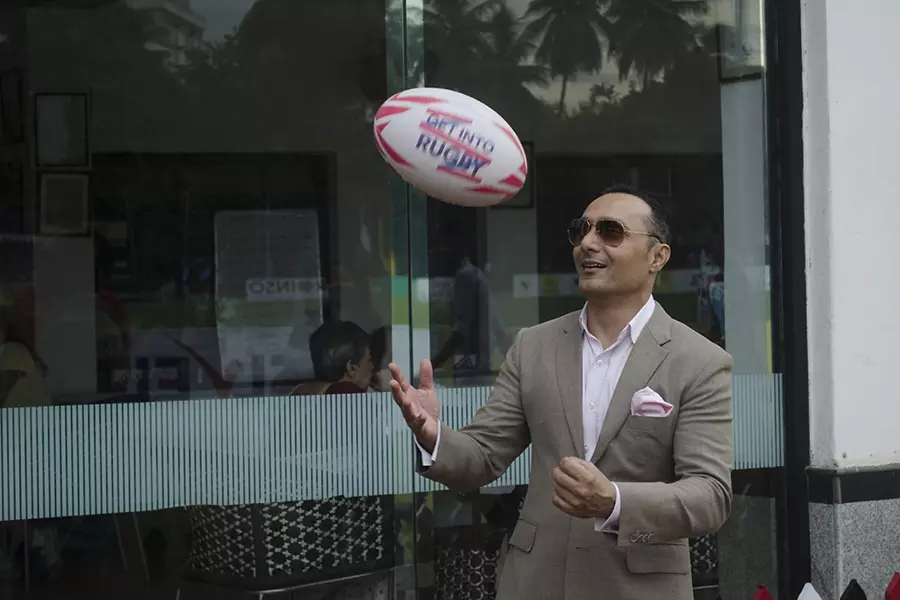
Rugby India President and Rugby Premier League Commissioner Rahul Bose
Excerpts from an exclusive interview
Rugby remains a niche sport in India. What is the one change that can accelerate its growth?
Any sport needs the oxygen of fan support and sponsor support and that invariably happens if you are available to be watched on mass media. In this case of course it is television, digital and so that would be a big accelerator in creating fan support and sponsor support and to a large extent RPL is the is one avenue through which we can put this sport out into the eyes and hearts and minds of the general public.
What has been the biggest milestone for Indian rugby over the past five years? Specially for RPL
We think the biggest milestone for Indian rugby in the last five years has been in the professionalizing of approaches, whether it's at the grassroots level and where the upskilling of coaches and PT teachers is concerned, giving assistance to all our state federations in that effort, and there are much larger efforts going to play out in the next five years, and also the professionalizing of approach in how you are nurturing and caring for your players at the high performance level, which is at the national level. And that we have instituted what we call a 360 degree support of high performance to our players, starting with psychology, nutrition, strength and conditioning, rehabilitation, players insurance, and even paying players for attending national camps and national duty. So that 360 degrees has been created so that our players can walk onto the field with absolutely the least amount of pressure and the maximum amount of comfort, both physical, mental and psychological.
Women's rugby is gaining visibility globally. How do you see the Indian women's team evolving?
The evolution of the women's Indian team has been very heartening. Like all team sports, it is a slow progress and it is something that can't be measured in a linear fashion. But overall, the federation is very happy with the progress our women's teams are making.
This is buttressed and supported, not least by the fact that our age grade, under 18, under 20, players who are women are being looked after better. So are the men, of course. But with the women, we are finding results a little bit quicker because the nation pool in international women's rugby is a little smaller and also the professionalization with which women's rugby was started in India was a few years after we started men's rugby. So they have the advantage of processes that have been tried and trusted and have been approved and we are using them to move forward.
What role can schools and colleges play in creating a stronger rugby culture in India?
As we all know, if you want to build a sport which a nation can perform at the highest level, then you have to spot, scout and pick children from school. In rugby, because it is a physical game, we first start with touch rugby in schools, where the kids are as young as 10, 11 and 12. And then of course, we move into semi-contact rugby for the under-15s, and then into full-contact rugby after that.
So, already the entire grassroots system is based around outreach to schools, communities, and in the districts, maybe a cluster of schools, where the intervention happens with a cluster of schools and not just one school. And of course, through the coaches, as well as upskilling PT teachers to get them to buy-in to including rugby in their programme. So, right now, all the thrust has been in schools, in rural areas, in the hinterlands, but gradually, the plan is to move also into schools in urban areas, so that they will also begin to pick up the sport.
And with the RPL, there are also cities that these players, these first-time trios of rugby can get behind their teams and create a kind of a support base for their teams, and also watching their teams play will give them wind beneath the wings to continue their sport.
Hyderabad has a strong sporting ecosystem. How important is the city to Rugby India's development plans?
Hyderabad is in any case the main focal point of rugby development in Telangana. And from there, all the efforts spread out across the entire state. So, as far as the state association is concerned, of course, it plays a very important role.
But since there is a Hyderabad Heroes team in the RPL, there is even more impetus for the sport to gain traction in the city. And as I said earlier in the earlier question, there is going to be a schools outreach, starting with the six cities where the RPL is based. So, that will further increase the importance of Hyderabad in contributing to Indian rugby.
Looking ahead, what is your biggest ambition for Indian rugby over the next decade?
I won't call it our ambition but our biggest hope for Indian Rugby in the next decade is for both our teams to gain entry into the Olympics and for that we have to reach at least the top two in Asia. Our women are ranked sixth in Asia right now so they have to move up four places and we are hoping they will do that by 2032 Olympics and our men are ranked 12th in Asia and we have built a pathway for them to hopefully proceed and make the top two in Asia by 2036 Olympics.
What can the city expect from Rugby Premier League this year?
The city can expect the best rugby on the planet, at least in and around these few months. The city can expect the best players in the world, playing with the best Indian players in the country. Our men and women are participating this time in RPL men and women's. This time there's not only RPL men, there's RPL women. So, everybody is very excited to give the women's game the same importance as the men's game is given. That has always been the creed within Rugby India and we want to spread that creed into the RPL.
The game is very easy to understand. The game is very exciting. It's very, very fast. It's very physical. So, there is something happening every few seconds in a sevens rugby game. And since a game is four minutes of four quarters each, a total game is about 20-22 minutes. So, it isn't something that you have to sit and wait for something to happen over a long period of time. There is a score in sevens rugby every 90-120 seconds. So, it's continuous excitement, easy to understand with the best players in the world. So, it's a win-win-win.
( Source : Deccan Chronicle )

Next Story