Aksomaniac’s music blends Malayalam rhythm and blues rooted in colourism, queer identity, mythology and storytelling
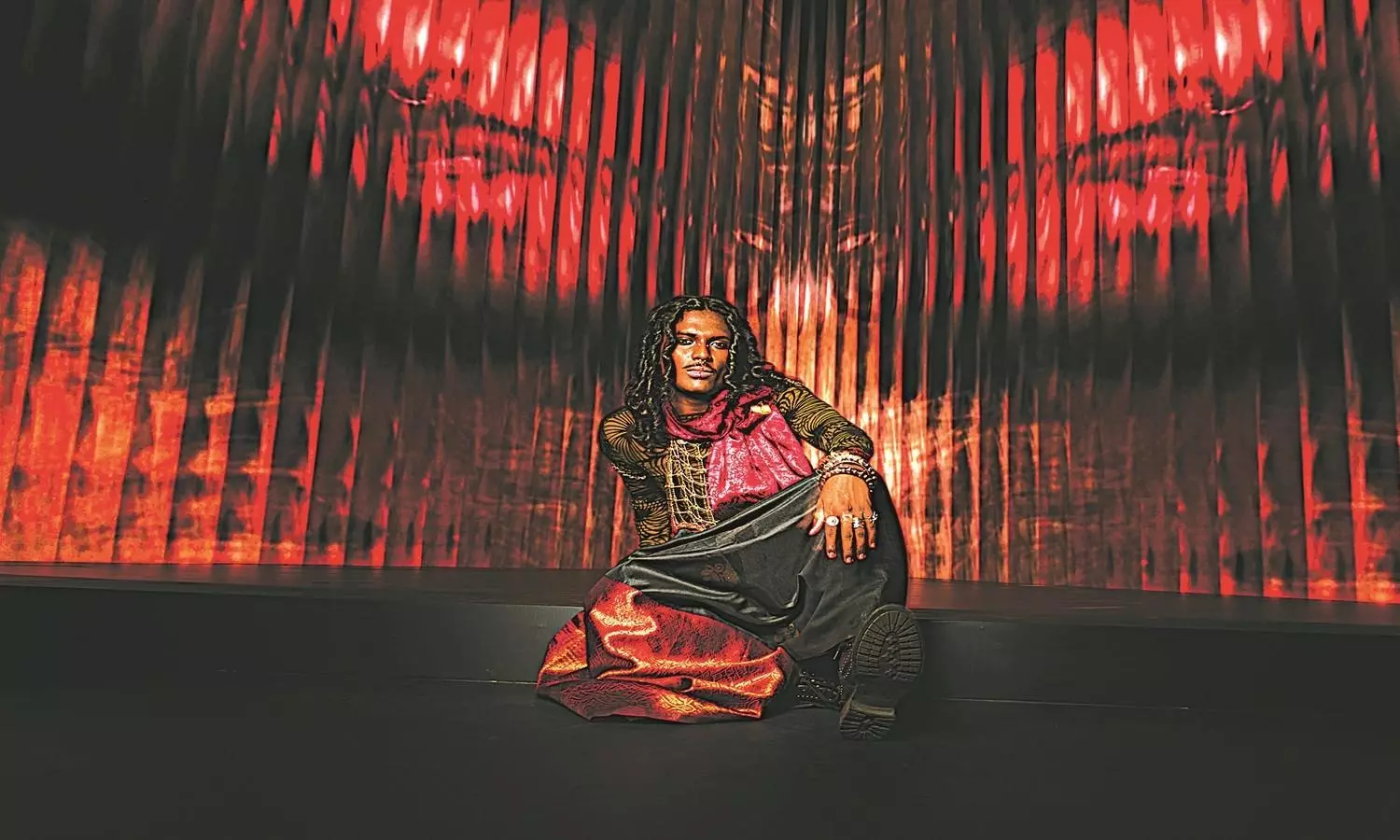
His songs cut deep. They stir the soul. No wonder his viral track ‘Amsham’ soared over global charts. At just 22, Aksomaniac is an icon in many ways.
His fan following is in epic proportions. His songs reveal the unexplored and untold stories of the Indian subcontinent. His music blends Malayalam rhythm and blues (R&B), queer identity, mythology, and storytelling. He’s a true ‘iconoclast’ and ‘original’ artist.
Illustrious Track Record
Aksomaniac mixes pop sensibility with avant-garde sensitivity. In ‘Karupp’, he explores colourism through societal perceptions. “Growing up in India as a dark-skinned person, there’s a lot you go through.”
In ‘Amsham’, he explores vulnerability. “It talks about what you go through while falling in love. But one thing with my songs — if I’m saying something, it’s probably true. I’m conversing with you,” he says.
The kind of music Aksomaniac gravitated towards was sex-positive and direct. It felt like the artist was talking about his/ her/ their truth directly to the listener. That consciousness became central to Aksomaniac’s own work. When he began writing in Malayalam with his project ‘Varthamanam’, he found a gap he felt compelled to fill. “Literature, when it comes to music in Malayalam, never really held space for queer voices, queer stories,” he explains.
Reworking Mythology
He has been expanding on the figure of Manmadhan, the sex god, a cursed entity banished from heaven, introduced in ‘Kanmashi’, explored further in ‘Amsham’, and in the upcoming project.
Aksomaniac’s work bends mythology to reflect contemporary queer realities. “I’m taking a concept where I’ve talked about my sexuality and interlaced it with mythology, and now I’m taking that to a whole other level,” he says.
His relationship with mythology is personal. He adds, “I grew up around stories where queerness and openness existed within mythology, but somewhere along the way, those narratives started being retold in ways that felt queerphobic.” That shift is troubling. In the past, there have been other artists like Lou Reed, who sang about trans characters. Homo-sexuality was a truth of Freddie Mercury as well as Adam Lambert.
Language As Identity
Language is central to his identity. “It’s about resonating with Malayalam and understanding myself as a Malayali through that process. These are Mallu boy problems,” he says, laughing. “When I write in English, it doesn’t feel represented well.” He strives to give back to the community. “The people I write with, work with – most of them are queer. So, it’s only right to give back to that community.”
In an age where music is produced and consumed at overwhelming speed, Aksomaniac believes narrative is what anchors an artist. “It’s very easy to get lost today. I’ve kept my personal politics very narrative-focused, storytelling-focused. People come to my music for that, and I’m happy they recognise it.”
Anomaly in Scene
He firmly believes in the art of conversation and kindness. Aksomaniac is an anomaly. His journey has been less about fitting in and more about creating space for himself, his community, and stories that rarely make it into mainstream music.