Unveil 13 outcomes after Nice talks
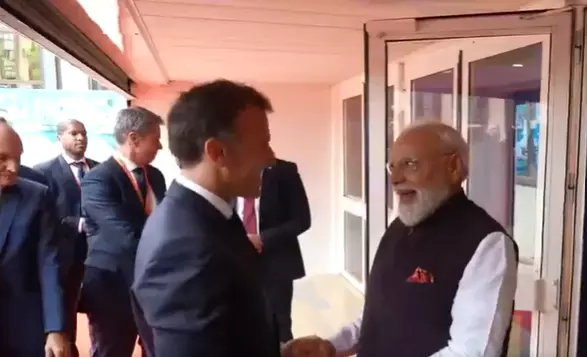
Welcoming Prime Minister Modi to Nice, Macron noted that the event follows the launch of the France-India Year of Innovation and serves as a platform to connect Indian startups and innovators with French partners, investors and researchers. Macron also congratulated PM Modi on becoming India's longest-serving Prime Minister since independence. — X.com
13 Nice outcomes
• Trade mechanism
• Economic security dialogue
• AI working group
• Digital sciences centre
• Aeronautics skilling centre
• Rail cooperation
• Classified information pact
• Space cooperation
• UPI expansion
• Start-up incubation
• ICCR chair
• Health cooperation
• Economic dialogue
New Delhi: Prime Minister Narendra Modi and French President Emmanuel Macron held extensive bilateral talks at the iconic Villa Kerylos in Nice on the French Riviera on Sunday, after which the two sides announced 13 outcomes, including a high-level mechanism to double bilateral trade in five years.
The two countries also agreed to institute an Economic Security Dialogue to strengthen supply chain resilience, particularly in critical minerals, and signed a General Security Agreement on the exchange and protection of classified information. Besides, 19 agreements were signed among institutions in the innovation ecosystems of the two countries.
Ahead of the talks, Modi said India-France ties were driven not only by shared interests but also by a shared vision. He described the partnership as one “marked by connection and conviction, embodying innovation and inspiration, and founded upon shared values.” Macron also hailed France’s “unique” ties with India.
At their first meeting since India-France ties were elevated to a “Special Global Strategic Partnership” earlier this year, the two countries decided to further intensify defence cooperation, with focus on co-design, co-development and co-production of defence platforms and advanced technologies.
New Delhi said the two leaders expressed satisfaction at the growth and depth of bilateral defence cooperation across all domains. The proposed Rafale deal, under which India intends to acquire 114 French Rafale fighter aircraft for the Indian Air Force, was also discussed. Most of the aircraft are proposed to be manufactured in India.
The two leaders also exchanged views on global issues, including the situations in West Asia and Ukraine.
The two sides adopted the India-France Innovation Roadmap 2030 and decided to create a joint Artificial Intelligence Working Group focused on AI governance. They also agreed to establish a Centre of Digital Sciences and signed an MoU for a National Centre of Excellence for Skilling in Aeronautics and Allied Sectors at NSTI, Kanpur. A Declaration of Intent on cooperation in railway and high-speed railway development in India was also signed.
In the space sector, both sides discussed further collaboration in human spaceflight and space situational awareness, following a Letter of Intent on cooperation in microgravity research and human space exploration. They also discussed ways to expand private sector collaboration in space.
On civil nuclear energy, both sides noted that India’s SHANTI Act had created new opportunities for collaboration, including in small and advanced modular reactors. Foreign secretary Vikram Misri later said technical and financial aspects of the Jaitapur civil nuclear project in Maharashtra were discussed.
Other outcomes included expanded possibilities for using India’s Unified Payments Interface (UPI) in France, which will soon be extended to airports in Paris and Nice. The two sides also agreed to incubate 10 more Indian start-ups at Station F in Paris and establish an ICCR India Chair on “AI, Innovation and Culture” at Université Paris-Saclay.
The two leaders reviewed progress under the Horizon 2047 Roadmap and discussed ways to strengthen ties in economic growth, technology, innovation, talent mobility, people-to-people exchanges and culture. They also called for early implementation of the India-EU Free Trade Agreement.
On people-to-people ties, Modi thanked Macron for the swift operationalisation of visa-free transit for Indian nationals at French airports. The two leaders discussed ways to enhance the mobility of talent and students and expand mutual recognition of educational qualifications. Modi also invited French universities to open campuses in India under the New Education Policy.
Earlier, Modi and Macron jointly inaugurated “Bharat Innovates 2026” at the Palais des Expositions in Nice. Addressing over 350 investors and venture capitalists from across the world, Modi urged them to “come to India, work with us, design in India, develop in India and create solutions for the world.”
“Innovation is in India’s DNA,” Modi said, adding that India had built a strong innovation ecosystem over the past 11 to 12 years. “Today, India is the world’s third-largest start-up ecosystem,” he said.
Bharat Innovates, a three-day event, brought together Indian deep-tech start-ups, innovators, researchers and investors with global innovation funds. The event showcased 120 start-ups and more than 20 Institutes of Excellence across 13 critical technology sectors.
Modi called upon innovators, investors and entrepreneurs to develop technologies that are trusted, inclusive and human-centric. He said start-ups should be judged not only by market valuation but also by their impact on humanity.
The Prime Minister also interacted with start-ups and innovators working in quantum computing, semiconductors, biotechnology, defence, space, healthcare, MedTech, advanced materials, clean energy and other frontier sectors.
( Source : Deccan Chronicle )


Next Story