India-Nepal Boundary Dispute Can Be Resolved With Open Heart, Mutual Respect: Nepal FM

7 Jun 2026 6:32 PM IST7 Jun 2026 6:32 PM IST
Speaking to media after concluding his three-day tour to India during which he held wide ranging talks with External Affairs Dr S. Jaishankar, Mr Khanal underlined that the new government in Kathmandu does not look at India through the "distorted, hyper-sensitive lens of 21st century geopolitics" and instead aims to see it with "clear eyes and a single transparent agenda of economic transformation of Nepal"
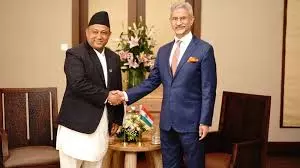
On Nepal's objection to using its route for the Kailash Mansarovar Yatra, the minister said that Kathmandu has a problem with India and China using the Nepal route without its content. — Internet
New Delhi: Nepal’s foreign minister Shishir Khanal on Sunday said his government seeks to resolve the border dispute with India through diplomatic means, stressing that “no problem is too large, and no boundary too complex” if addressed with mutual respect.
Speaking after a three-day visit to New Delhi, during which he held talks with external affairs minister S. Jaishankar, he said the new government in Kathmandu aims to engage India with a focus on economic transformation and cooperation.
He said Nepal wants to build a mutually beneficial relationship and deepen bilateral ties. Referring to the Kailash Mansarovar Yatra route, he said Kathmandu’s concern was over agreements between India and China involving areas such as Kalapani and Lipulekh without Nepal’s consent.
“Kailash Mansarovar Yatra happens through very different border points. Many travel through Nepal. Our concerns are with the renewal of the agreement between India and China through the Kalapani and Lipulekh area, where we have said for a very long time that the land belongs to us, and without Nepal's consent, the two countries by themselves cannot make those agreements. And we have made that very clearly known through our communication, including diplomatic notes to both countries,” he said.
Referring to disputes over Lipulekh, Limpiyadhura and Kalapani, he said shared borders should function as “efficient bridges” rather than barriers.
“Let us build a partnership that is not constrained by the anxieties of the past, but one that is fuelled by the high hopes and promising prospects of our shared future,” he said.
The visit came amid controversy following remarks by Nepal Prime Minister Balendra Shah on the boundary issue, including a suggestion on involvement of China and the UK, which India has rejected.
Clarifying the remarks, the minister said reference to the UK was limited to accessing historical documents from archives and not for mediation.
“We want to solve our disputes through diplomatic processes. We just want to see if we can access some of the documents that might be in libraries or museums in the UK. Our position was not that we were asking for mediation,” he said.
“Rather than engaging in hyper-nationalistic grandstanding, we are pursuing calm, data-driven and evidence-based discussions to resolve challenges in good faith…No problem is too large, and no boundary too complex, when we sit down with an open heart, a rational mind and mutual respect,” he added.
He said Nepal remains committed to resolving the issue through existing bilateral mechanisms and strengthening ties with India, describing the country as a fast-growing global economic and technological power.
( Source : Deccan Chronicle )

Next Story