Ted Turner, CNN Founder, 24-Hour TV News Pioneer, Dies At 87

6 May 2026 8:27 PM IST6 May 2026 8:27 PM IST
In September 2018 Turner revealed that he had Lewy body dementia, a degenerative nerve disease.
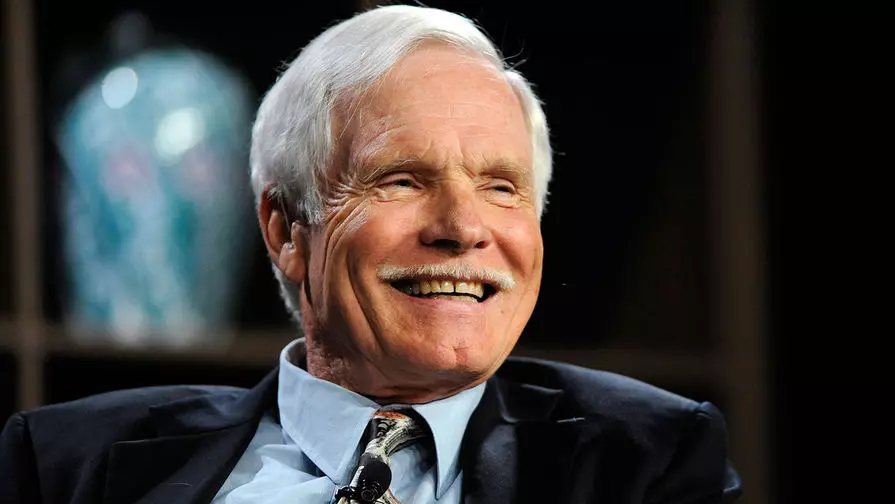
Ted Turner, the brash sportsman and entrepreneur whose ambition and instincts led to a media empire that included groundbreaking news network CNN, has died, CNN reported on Wednesday citing a press release from Turner Enterprises. He was 87. (Photo: X)
Washington: Ted Turner, the swashbuckling billionaire who founded CNN, the first 24-hour news channel in the world, and turned his company into one of the biggest US cable-television systems before selling it to Time Warner Inc., has died. He was 87.
He died on Wednesday, CNN reported, citing a news release from his company, Turner Enterprises. He had announced in 2018 that he was suffering from Lewy body dementia, a progressive brain disorder, and largely disappeared from public life after that.
Few media tycoons had a more tumultuous and varied career, or pursued their passions more publicly, than the man whose nicknames included Captain Outrageous and The Mouth of the South.
While serving up quips and wisecracks that entertained and offended, he created cable TV networks such as the Cartoon Network, TBS and Turner Classic Movies, along with CNN; bought the Atlanta Braves baseball team and the Atlanta Hawks basketball team; and married and divorced Hollywood star Jane Fonda.
An ardent conservationist, he became one of the nation’s largest individual landowners, with estimated holdings of 2 million acres (about 809,000 hectares) in eight states — plus their more than 45,000 bison. As a philanthropist, he pledged $1 billion to the United Nations in 1997. Turner’s estimated net worth was $2.8 billion, according to Forbes.
“If I only had a little humility, I’d be perfect,” he once said.
Dave Bristol, a former manager of Turner’s Braves, told a Turner biographer, “He just burns a different fuel than the rest of us.”
Turner “believed deeply in the power of ideas, in doing things differently and in building platforms that could inform, inspire and connect people around the world,” David Zaslav, chief executive of CNN’s parent, Warner Bros. Discovery Inc., said in a statement. “That belief inspired generations of leaders, myself included.”
The sale that was to be the capstone of Turner’s corporate career — the $8 billion acquisition of his Turner Broadcasting System Inc. by Time Warner in 1996 — ultimately cost him control of his empire and later his own job.
Time Warner was sold to America Online Inc. in 2001, and Turner became the largest individual shareholder of the new company and vice chairman. Once the internet bubble burst and few of the promised benefits of the combined companies came to fruition, the value of Turner’s holdings plunged by $7 billion, wiping out the bulk of his fortune. He openly criticized senior executives at the company before resigning his post in 2003, staying on as a director until 2006 while selling his Time Warner stake.
In 2016, Time Warner announced the sale of the media empire he helped create — including the cable channels CNN and TBS — to AT&T Inc. for $85.4 billion. As part of a new unit later named Warner Bros. Discovery, CNN became a frequent target of President Donald Trump, who derided the network as “fake news.” The industry that Turner pioneered became even more challenged by consumers dropping cable TV service for new online alternatives from Netflix Inc. and Amazon.com Inc.
CNN faces more possible changes ahead, with Paramount Skydance Corp. seeking to acquire its parent. David Ellison, Paramount’s CEO, is the son of Larry Ellison, a billionaire ally of Trump.
In a social media post reacting to Turner’s death, Trump praised him as “one of the greats of broadcast history, and a friend of mine.” He also blasted CNN and said he hopes its new owners “bring it back to its former credibility and glory.”
Turner thrived on taking risks, both personal and financial. His bright blue eyes, deeply cleft chin and shock of rusty brown hair that went silver in later years made him a magnet for the opposite sex — and his lack of restraint tripped him up on numerous occasions. He made little effort to conceal extramarital affairs during his first two marriages.
An uncompromising competitor, Turner reveled in his role as an outsider, a Southerner in an industry dominated by New York and Los Angeles. He would go to extraordinary lengths to gain an advantage. During a promotional contest for the Braves, he once pushed a baseball with his nose around the infield until his face was raw and bleeding.
He also could be insensitive and tactless at times. He once offended abortion opponents by calling them “bozos” and insulted Catholics who observed Ash Wednesday as “Jesus freaks.” He later apologised for those statements.
“It’s as if a child were speaking, without any social inhibitions,” former AOL Time Warner Chief Executive Officer Gerald Levin told New Yorker magazine writer Ken Auletta in 2001.
Robert Edward Turner III was born on Nov. 19, 1938, in Cincinnati, the oldest child of Florence Rooney Turner and Robert Edward Turner Jr., a salesman who bought several billboard companies in Georgia after World War II. The family moved to Savannah, but Ted was sent first to Georgia Military Academy near Atlanta, then to a military school in Chattanooga, Tennessee.
In a pattern that was to repeat itself over the years, Turner antagonized his debate team adviser and longtime dorm master so much that he was forced to find new quarters in his last year of high school, according to Citizen Turner, a 1995 biography by Robert and Gerald Jay Goldberg.
The story was similar at Brown University, where Turner’s freshman-year roommates were soon exhausted by his antics and moved out. Two years later, he was booted from his college fraternity house. He was expelled from the university for entertaining a female student in his dorm room while he was on suspension. Today, Brown hails him as one of its most prominent alumni.
After a brief stint in the US Coast Guard, Turner returned to Georgia to join his father’s company. His parents had divorced in 1957 and his father remarried. His sister, Mary Jane, was in the final throes of a losing battle with lupus, which killed her at age 19.
Turner proposed marriage to Julia Nye, a Northwestern University coed he had met during a sailing regatta in Chicago. The two wed in 1960 and had two children, Laura and Robert IV.
Nye later told the Goldbergs for their biography that she found Turner naked with another woman late one night at his office, but called the marriage quits only after he rammed the boat she was skippering in a sailing regatta to deprive her of a first-place victory.
Turner was 24 when his father sank into depression after doubting that he could afford the $4 million acquisition he’d recently made to expand his business to Atlanta, Richmond and Roanoke, Virginia. The elder Turner made arrangements to sell the new properties before he committed suicide.
Within days of the funeral, Ted Turner aborted the pending sale.
In the mid-1960s, he married Jane Smith, a stewardess he met in Atlanta. Their marriage produced three children — Beau, Rhett and Jennie. He also gained custody of the children from his first marriage. The marriage ended in divorce.
Turner grew restless with the billboard business and decided to branch into broadcasting. He acquired several radio stations, then in 1970 bought the ailing Atlanta TV station that he renamed WTBS. He originated the “superstation” concept in 1976 by beaming WTBS via satellite to cable systems, which were starting to displace traditional broadcast reception.
By then, Turner had become a world-class yachtsman, competing in regattas as far away as Australia and Norway. He was a four-time winner of the Yachtsman of the Year award and was inducted into the National Sailing Hall of Fame.
His 1977 defense of the America’s Cup at the helm of his yacht Courageous landed him on the cover of Sports Illustrated. Such exploits — along with his behavior, such as his inebriated appearance at the post-race news conference — earned him nicknames including Captain Outrageous and Terrible Ted.
In 1978, Turner began laying the groundwork for Cable News Network, now known as CNN. He faced unexpected obstacles in securing the financing and satellite transponders and couldn’t attract the biggest on-air talent, but still managed to launch the service as promised on June 1, 1980.
In late 1981, he added CNN Headline News to counter a competitive service started by Westinghouse and ABC. Westinghouse-ABC lost $60 million on their Satellite News Service before accepting $26 million from Turner to fold their operation in 1983.
Turner’s relentless enthusiasm for CNN proved infectious and heightened his interest in global issues. According to Hank Whittemore’s 1990 book, CNN: The Inside Story, Turner greeted one group of CNN recruits by saying, “See, we’re gonna take the news and put it on the satellite, and then we’re gonna beam it down into Russia, and we’re gonna bring world peace, and we’re all gonna get rich in the process!”
Fidel Castro was a CNN fan, and Turner accepted an invitation to visit Cuba in 1982. The two men went duck hunting, prompting Turner to call himself “the only American who’s come that close to Fidel with a gun in his hands in 20 years.” Upon his return, Turner said, “Fidel ain’t a communist. He’s a dictator, just like me,” former CNN President Maurice “Reese” Schonfeld wrote in his 2001 memoir, Me and Ted Against the World.
In 1985, Turner made a hostile bid for CBS Inc., offering a no-cash package of stock and high-yield bonds valued at $5.41 billion. CBS fought back and finally made Turner’s bid untenable by taking on almost $1 billion in debt to repurchase about 20% of its shares.
Smarting from defeat, Turner was receptive to Kirk Kerkorian’s invitation to bid for his 50.1%-owned MGM/UA Entertainment Co. After a hasty two-week review of the studio’s books, Turner agreed to pay $1.5 billion. He soon had to revise the deal and sold UA back to Kerkorian. Later, he sold the MGM name and other assets, retaining only the pre-1986 MGM film library, which boasted 3,650 titles, including Gone With the Wind and Casablanca.
The Hollywood foray was a tactical move to secure programming, but it was a bigger transaction than Turner could handle alone and ended his unfettered control of the company. To stay afloat, he accepted $562 million from a group of cable TV companies in 1987. The strongest two — Tele-Communications Inc. and Time Inc. — gained veto power over acquisitions.
Turner’s acumen for business faltered, though, when he tried to offer himself as a goodwill ambassador to the world. He dreamed up the Goodwill Games as an antidote to the politicized Olympics Games, and produced the event in 1986. The venture ceased operations in 2001 and lost about $150 million, according to a New York Times story at the time.
Turner met Fonda in 1987 and courted the actress and activist until 1991, when they were married at his plantation near Tallahassee, Florida. They divorced in 2001.
He never abandoned his goal of expansion, but his board blocked him at every turn. Turner accused Time Warner, in particular, of thwarting a 1993 bid for NBC and a 1995 run at CBS.
In 1995, he abruptly agreed to sell the rest of his company to Time Warner, which already held a 20% stake.
Turner backed Levin’s decision to sell the company to AOL in 2001, but by year’s end, displayed a severe case of seller’s remorse.
“I knew we were selling out,” he said. “I never thought in my wildest dreams that I would actually lose my job.”
( Source : Bloomberg )

Next Story